Noise Pollution, Property Value, and Sustainable Mitigation:
A Technical Review of Environmental and Economic Impacts
By Patrick Harkins, RMP Global
Environmental noise is widely recognized as a growing infrastructure and public health concern. Beyond annoyance, sustained exposure to transportation and industrial noise has measurable economic consequences and documented physiological impacts. A growing body of research demonstrates that chronic environmental noise affects residential property values, cardiovascular health, sleep quality, and community perception. Addressing these impacts requires technically sound mitigation strategies grounded in acoustical science and lifecycle sustainability principles.
Noise and Residential Property Value
The relationship between environmental noise exposure and residential property value has been extensively examined using hedonic pricing models. These models isolate environmental variables within real estate markets to quantify value impacts (Rosen, 1974; Nelson, 1982).
Meta-analyses of transportation noise studies consistently report a Noise Depreciation Index (NDI) of approximately 0.5–1.0% reduction in property value per additional decibel (dB(A)) increase in sustained environmental noise (Nelson, 2008; Bateman et al., 2001). In high-exposure conditions—such as properties adjacent to highways or rail corridors—total value reductions may range from 5% to 20%, depending on visual intrusion, duration of exposure, and community context (OECD, 2018).
The Federal Highway Administration (FHWA) recognizes that transportation noise can create “substantial adverse effects” on adjacent land uses when exposure exceeds established activity criteria (FHWA, 23 CFR Part 772). These economic impacts are closely tied not only to overall sound pressure levels but also to frequency composition and nighttime exposure.
Research shows that nighttime noise above 45 dB(A) is strongly correlated with sleep disturbance and perceived annoyance (WHO, 2018), factors that significantly influence residential desirability.

Health Implications of Environmental Noise
The World Health Organization’s Environmental Noise Guidelines (2018) classify transportation noise as a major environmental health risk in developed nations. Chronic exposure has been associated with:
- Increased risk of ischemic heart disease
- Hypertension
- Elevated cortisol levels
- Sleep Disturbance
- Cognitive impairment in children
The WHO recommends reducing long-term average road traffic noise below 53 dB Lden and nighttime levels below 45 dB Lnight to mitigate adverse health outcomes.
Mechanistically, environmental noise acts as a stressor, activating the hypothalamic–pituitary–adrenal axis and sympathetic nervous system (Babisch, 2014). Even when individuals report becoming “accustomed” to noise, physiological stress responses may persist.
Low-frequency noise presents particular mitigation challenges. Due to longer wavelengths, low-frequency sound diffracts more readily over obstacles and penetrates building envelopes more effectively than higher-frequency sound (Bies & Hansen, 2009). As freight and logistics activity increases, understanding frequency-dependent behavior becomes essential for effective mitigation.
Acoustic Fundamentals and Mitigation Mechanics
Environmental noise mitigation is often conceptualized through the Source–Path–Receiver model (FHWA, 2011). While source reduction (e.g., quieter pavements, vehicle standards) and receiver protection (e.g., building envelope upgrades) are viable approaches, barriers primarily interrupt the transmission path.
When a barrier obstructs the direct line of sight between source and receiver, it creates an acoustical shadow zone. The resulting reduction, known as insertion loss (IL), depends on barrier height, length, placement, and material performance (Maekawa, 1968; FHWA, 2011).
However, three physical mechanisms limit effectiveness:
- Diffraction – Bending of sound over the barrier top
- Flanking – Sound wrapping around barrier ends
- Transmission – Sound passing through the barrier material
Barrier geometry is therefore critical. FHWA guidance indicates that placing barriers closer to either the source or receiver typically maximizes acoustical benefit.
Material performance is commonly evaluated using:
- Sound Transmission Class (STC) — quantifies resistance to airborne sound transmission (ASTM E90)
- Noise Reduction Coefficient (NRC) — quantifies absorptive performance (ASTM C423)
In transportation corridors, reflective barriers may redirect sound toward opposing receivers. Incorporating absorptive treatments can reduce reflected energy and improve net community benefit (FHWA, 2011).
Sustainability and Lifecycle Performance
Modern infrastructure projects increasingly evaluate noise mitigation not only by acoustical performance but also by environmental impact. Lifecycle assessment (LCA) methodologies consider embodied carbon, material sourcing, manufacturing emissions, service life, and end-of-life disposition (ISO 14040).
Long service life significantly reduces environmental burden. Barriers designed to perform for 50+ years lower replacement frequency and reduce cumulative embodied emissions. Reduced maintenance requirements further decrease environmental impact over time.
Recycled material integration also plays an expanding role. Diverting post-consumer or post-industrial materials into durable infrastructure applications can reduce landfill demand and lower virgin material extraction. When engineered properly, recycled-content wall systems can maintain structural performance and acoustic ratings comparable to traditional materials.
From a sustainability perspective, total cost of ownership—including durability, maintenance cycles, and recyclability—often outweighs initial installation cost in long-term infrastructure planning (OECD, 2020).
Aesthetics and Community Integration
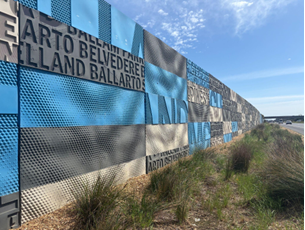
While technical metrics determine acoustic performance, community acceptance influences overall project success. Studies in environmental psychology suggest that visual integration moderates perceived noise annoyance (Gidlöf-Gunnarsson & Öhrström, 2007). Architecturally refined surfaces and context-sensitive design can therefore enhance both functional and perceptual outcomes.
Noise mitigation infrastructure that integrates visually with surrounding landscapes supports broader property value stabilization goals.


Conclusion
Environmental noise pollution is both an economic and public health issue supported by decades of empirical research. Hedonic pricing analyses demonstrate measurable reductions in residential property value with increasing noise exposure, while epidemiological evidence links chronic exposure to cardiovascular risk and sleep disturbance.
Effective mitigation requires technically grounded barrier design informed by acoustical science, including geometry optimization, transmission resistance, and absorption management. Increasingly, sustainable lifecycle performance and recycled material integration are central to infrastructure evaluation.
Mitigating environmental noise is not solely about reducing decibel levels. It is about protecting community value, improving long-term health outcomes, and delivering durable, sustainable infrastructure aligned with contemporary environmental standards. Organizations such as RMP Global are working within this framework — combining engineered acoustic performance, long-term durability, and responsible material integration — to support infrastructure solutions that balance environmental, economic, and community priorities.
Key References
Babisch, W. (2014). Updated exposure-response relationship between road traffic noise and coronary heart diseases: A meta-analysis. Noise & Health, 16(68), 1–9. https://doi.org/10.4103/1463-1741.127847.
Bateman, I. J., Day, B. H., Lake, I. R., & Lovett, A. A. (2001). The effect of road traffic on residential property values. The Stationery Office.
Bies, D. A., & Hansen, C. H. (2009). Engineering noise control: Theory and practice (4th ed.). CRC Press.
Federal Highway Administration. (2011, December). Highway traffic noise: Analysis and abatement guidance (Report No. FHWA-HEP-10-025). https://rosap.ntl.bts.gov/view/dot/63200
International Organization for Standardization. (2006). Environmental management—Life cycle assessment—Principles and framework (ISO Standard No. 14040:2006). https://www.iso.org/standard/37456.html
Maekawa, Z. (1968). Noise reduction by screens. Applied Acoustics, 1(3), 157–173. https://doi.org/10.1016/0003-682X(68)90020-0
Nelson, J. P. (2008). Hedonic property value studies of transportation noise: Aircraft and road traffic. In A. Baranzini, J. Ramirez, C. Schaerer, & P. Thalmann (Eds.), Hedonic methods in housing markets (pp. 57–82). Springer. https://doi.org/10.1007/978-0-387-76815-1_4
Organisation for Economic Co-operation and Development. (2018). Environmental noise and property value impacts. OECD.
Organisation for Economic Co-operation and Development. (2020). Environmental noise and property value impacts. OECD.
World Health Organization. (2018). Environmental noise guidelines for the European Region. https://www.who.int/publications/i/item/9789289053563