Advancements in Remote Noise Monitoring: How Directional Sensing, AI, and New Metrics Are Transforming Acoustic Analysis
By Marek Kovacik, Sales Manager, Scantek, Inc.
Across a wide range of industries, the need for more intelligent, automated, and context-aware monitoring continues to accelerate. Traditional sound level meters, while accurate in measuring levels, fall short in revealing where noise originates, which noise is relevant, and how to separate meaningful acoustic data from the clutter of complex urban soundscapes. Recent innovations demonstrate how emerging tools like directionofarrival detection, machine-learning classification, and new metrics such as Partial Leq, are pushing noise monitoring into a new era of precision and automation.
Smarter Sensing Using Directional Technology
At the center of this transformation is the evolution of time-difference-of-arrival (TDOA) directional devices. Unlike traditional microphones, these small, multi-microphone arrays determine and classify the 3D direction of a sound source by using cross-correlation between microphone signals to compute its angle of arrival.
Studies examining TDOA directional devices in both controlled test rooms and realworld environments highlight their capability to reliably identify dominant noise sources, even in indoor spaces with minimal reflective surfaces. When placed in noisy environments with mixed sources, the devices consistently pinpointed arrival angles that matched observers’ notes.
Using a noise monitoring management system, several independent TDOA sectors of interest can be defined in both the vertical and horizontal planes. In combination with a calibrated measurement microphone, the system enables advanced data processing, including selecting whether values from other sectors should be included in the total background noise, or excluded so that only relevant noise levels are reported using the Partial Leq metric (as discussed in more detail below). This system allows users to generate reports that summarize the noise contribution from each directional sector over a given period.
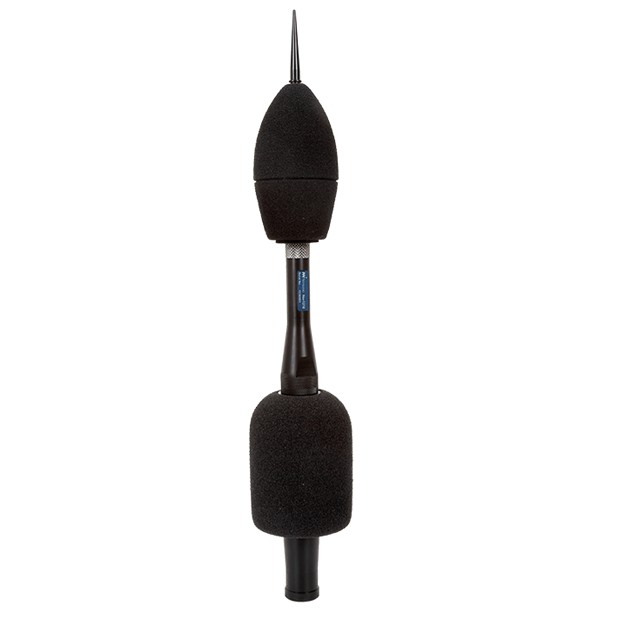
Figure 1: TDOA directional device attached to the bottom of an outdoor Class I microphone protection kit.
AIDriven Noise Event Identification
Another major innovation reshaping noise monitoring is the application of machine learning for automatic sound classification. Systems incorporating this technology can automatically categorize recorded audio events captured during environmental monitoring. The goal is to differentiate between noise produced by the activity being studied and noise from unrelated sources. Such systems may entirely operate within the noise monitoring management system’s workflow, using existing measurement data and audio recordings.
The system allows users to define source labels that focus on the events relevant to the analysis for a particular project. By default, all labeled events are considered part of the activity, unless the user specifically marks them as non-activity.
Recorded events that haven’t been trained or explicitly categorized are classified as unknown. By design, unknown events are treated as part of the activity. This method eliminates the need to classify every potential sound, allowing the analysis to concentrate on excluding only those sources that are known to impact the results and do not belong to the activity being studied. If a more detailed classification is required, additional source categories can be introduced and trained as needed, but this level of detail is optional and project-dependent.
At the start of a project, the AI model is trained using representative audio samples chosen by the user and assigned to the appropriate source labels. In practice, only a small number of samples is needed for reliable classification, though more can be added if desired. This project-specific training enables the AI model to quickly adjust to the unique acoustic conditions of each site. Unlike generic pre-trained models, classification is based on sounds that occur within the project, ensuring the results accurately reflect local conditions, operating patterns, and source characteristics.
Such models can be retrained at any stage of the project to accommodate changes in source labels or classification criteria. This flexibility allows the model to adjust when new activity types are introduced or when more detailed source categorization is needed, ensuring the classification remains relevant and accurate throughout long-term monitoring projects.
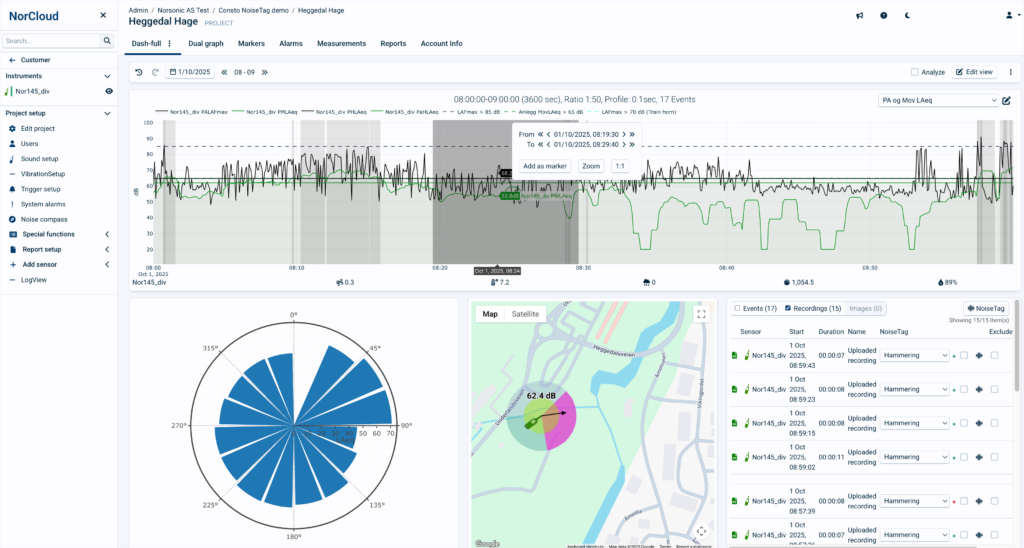
By using a remote noise monitoring management system and directional classification using a TDOA device, automatic sound classification can not only determine the type of sound, but also where it’s coming from and how it should be treated for inclusion in noise assessment metrics.
Figure 2: Automatic sound classification alongside noise level data inside of a remote noise monitoring management system for a noise monitoring site.
Separation of Levels using Partial Leq
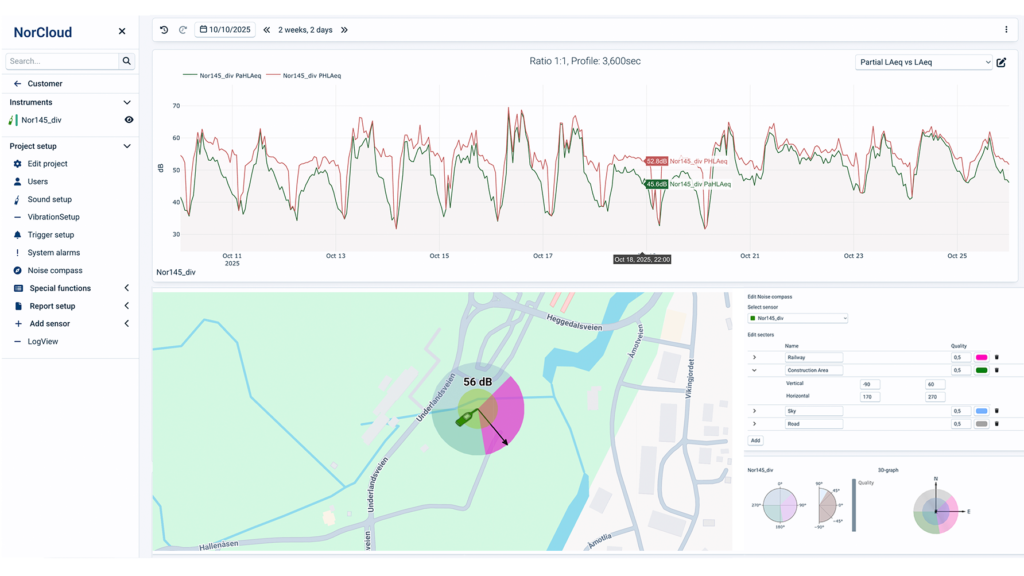
Environmental monitoring has traditionally struggled with residual noise, which can mask or contaminate measurements of a target source. Standards such as ISO 19962 prescribe methods to remove or correct irrelevant contributions, but these require detailed knowledge of unwanted events, information that is nearly impossible to gather manually during longterm unattended monitoring. The introduction of Partial Leq, a new metric proposed in recent research, rethinks this problem by automatically classifying and replacing irrelevant noise samples with projectspecific values. When combined with directional classification using a TDOA device, or automatic classification of recorded noise events using AI, Partial Leq enables more accurate estimates of a source’s true contribution, especially in complex settings where multiple sources continuously overlap.
Figure 3: Separation of noise levels using Partial Leq inside of a remote noise monitoring management system calculated from time-difference-of-arrival sectors at a noise monitoring site.
Combining Directional Acoustics with AI Intelligence
Together, these technologies highlight a clear direction: the integration of automated directional and event classification with new analytical metrics is reshaping the potential of noise monitoring. As cities keep growing, construction activity accelerates, noise monitoring systems must evolve from passive loggers into intelligent diagnostic instruments. Cloud-based measurement management systems like Norsonic’s NorCloud, TDOA directional devices such as Norsonic’s Noise Compass, and AI-powered automatic sound classification tools like Norsonic’s NoiseTag will be the tools enabling professionals to measure more accurately and diagnose more clearly.
The best part? These technologies are no longer dreams of wish lists. They’re here, real, and available as turnkey solutions (no deep pockets required).
Scantek, Inc. serves as the North American office for Rion-Norsonic, delivering advanced sound and vibration measurement instrumentation, software, and accredited calibration.
More information on Noise Compass, NoiseTag, Partial Leq, and the research behind these tools can be found on Norsonic’s website: www.norsonic.com