Developing a noise footprint framework
By Angelos Tsaligopoulos, Francesco Aletta, Gianluca Maracchini, and Simone Torresin
1. Why talk about a “noise footprint” now?
The following question may seem ridiculous. Which is louder: a highway road, a motorcycle or the rider’s helmet? A product, a service, or an infrastructure can be noisy when used. Nevertheless, it is also possible that a product may be quiet in use but manufactured under very noisy conditions. Does this mean that you may unknowingly contribute to noise pollution simply by using a product? Is the user the sole party responsible for the noise produced? Noise produced “elsewhere” still matters and can be harmful in the long run. Even if it is not audible to us directly, it may be disruptive to someone else or to wildlife far away. Environmental noise is the second-largest cause of health problems, behind air pollution [1], affecting the quality of life and environmental integrity. Noise is a global issue, but its assessment remains local and focuses on specific exposure conditions. This approach is crucial for urban planning and noise management, but fails to answer a different kind of question: “who is responsible for noise across complex production and consumption systems?”. With noise pollution reaching near‑epidemic proportions [2], more effective approaches are needed. Instead of treating noise as an unavoidable fact of life and relying on local fixes that ignore deeper causes, a systemic shift is needed, one that aligns noise management with environmental sustainability and moves from reactive control to preventive, holistic strategies. The noise footprint framework can provide such solutions.
2. What is a footprint and why it matters?
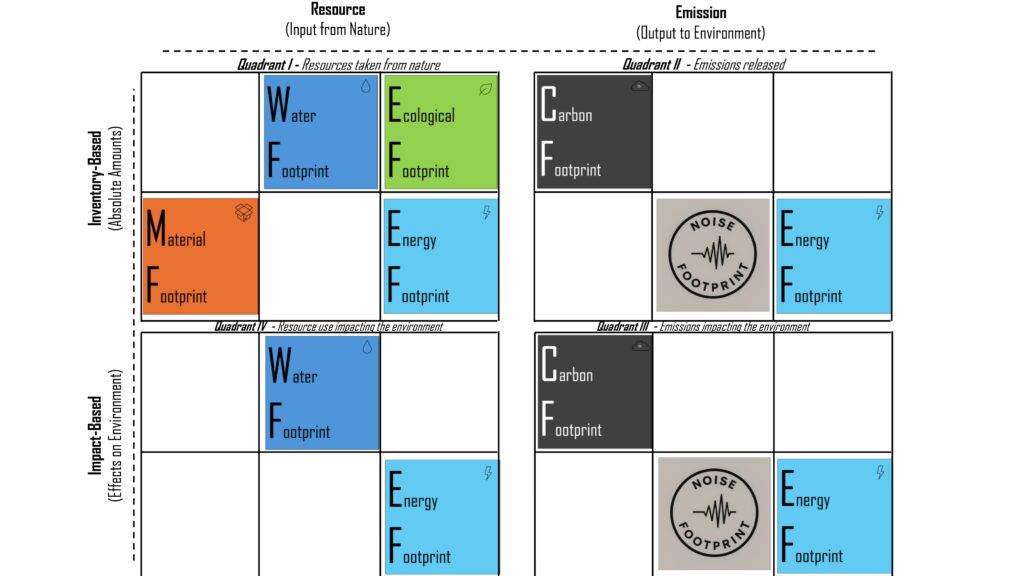
Environmental footprinting has transformed how society discusses responsibility, sustainability, and even everyday choices. It stands as a series of sustainability metrics, functioning as diagnostic tools that enable the detection and quantification of environmental and health impacts and support comparisons among products, services, and individual actions. Footprints can be classified according to their intended use and the environmental aspect they address, such as water, energy, or carbon footprints [3]. Footprints indicate an object dimension describing what the footprint analyses (i.e., “the footprint of…”) and a theme dimension that describes the effects or outcomes of the footprint (i.e., “the footprint on …”). They can be classified as inventory‑oriented footprints quantifying emissions in absolute terms and as impact‑oriented footprints characterizing emission inventories according to their contribution to specific environmental problems (see figure 1). Additionally, personal footprint calculators can motivate individuals to reduce their environmental impact, serving as awareness tools, yet they may also be perceived as mechanisms for shifting responsibility. Footprinting approaches, especially those applied to products, are often linked to Life Cycle Assessment (LCA), a method that evaluates impacts across all stages of a product or service life, from raw material extraction and manufacturing to use and end-of-life.
3. What is a noise footprint?
A similar logic is now emerging for noise. The noise footprint aims to extend noise assessment beyond isolated sites and single sources, by embedding noise into the structure of life cycle thinkingandsupply-chain attribution. The concept of a noise footprint has appeared in literature since the 1970s. It has been used mainly in aviation and underwater acoustics to describe the geographic area affected by noise. However, because the term “footprint” is intuitive, it is often used loosely to imply noise impact without life cycle thinking or broader environmental footprint logic [4]. A unified definition and quantification method are still missing. To this end, the noise footprint is still an emerging measure for assessing and communicating noise impacts. Instead of focusing only on the noise emitted at a single location, it asks how noise is generated across the entire system that delivers a product or service. It is a way to quantify the noise burden associated with an activity (such as mobility, construction, industrial production, or consumption), including the processes that enable it. It includes the “use phase” of a product but can also cover noise generated during raw material extraction, manufacturing, transport, installation, operation and end‑of‑life processes. At the product level, a noise footprint captures source–receiver dynamics and extends across entire supply chains. Rather than a single fixed metric, it is best understood as a structured indicator with two possible levels of resolution: an emission-based core inventorying the sound energy output of interconnected sources, specified by frequency band and relevant spatial and temporal descriptors, and an impact-based extension derived from that core by incorporating who or what is exposed.
4. Not just noise mapping
A common misunderstanding is to treat the noise footprint as a rebranding of traditional noise mapping. The two approaches are complementary but address different questions. Noise mapping is typically site‑specific, exposure‑driven and used primarily for regulatory compliance and mitigation planning. The noise footprint embeds responsibility and attribution across a supply chain, identifies noise “hotspots” across different stages of production, and aligns noise with sustainability accounting practices such as trade‑offs and compensation [5].
5. Emerging opportunities
A major opportunity for the noise footprint lies in integrating soundscape thinking. Soundscape research shows that people’s experience of the sound environment shapes well‑being, highlighting the value of restorative sound environments and positive auditory experiences [6]. Embedding these perceptual dimensions would allow the footprint to incorporate soundscape interventions as potential offset mechanisms, expanding the framework toward broader health and well‑being benefits. The framework can also extend to non‑human receptors and indoor environments and complement existing noise reporting, supporting integration of noise into wider sustainability assessments.
Funding
This work was funded by HEAD-Genuit-Stiftung as part of the “Noise Footprint” project (P-23/01-W).
References
1. European Environment Agency (EEA) (2025) Environmental noise in Europe 2025. Luxembourg: Publications Office of the European Union, 2025
2. Europe TLRH- (2023) Noise pollution: more attention is needed. The Lancet Regional Health – Europe 24:. https://doi.org/10.1016/j.lanepe.2022.100577
3. Fang K, Song S, Heijungs R, et al (2016) The footprint’s fingerprint: on the classification of the footprint family. Current Opinion in Environmental Sustainability 23:54–62. https://doi.org/10.1016/j.cosust.2016.12.002
4. Tsaligopoulos A, Aletta F, Maracchini G, Torresin S (2026) Towards a noise footprint framework: a scoping review. Applied Acoustics 243:111124. https://doi.org/10.1016/j.apacoust.2025.111124
5. Tsaligopoulos A, Aletta F, Maracchini G, Torresin S (2025) Rethinking environmental noise assessment through a noise footprint framework. Noise Mapping 12:. https://doi.org/10.1515/noise-2025-0019
6. Aletta F, Oberman T, Kang J (2018) Associations between Positive Health-Related Effects and Soundscapes Perceptual Constructs: A Systematic Review. International Journal of Environmental Research and Public Health 15:2392. https://doi.org/10.3390/ijerph15112392