Environmental and recreational noise exposure in youths
By Sergio Mora Camargo, student, Monterrey Institute of Technology and Higher Education (ITESM)
Youths in Latin America are particularly exposed to high levels of noise in their daily environment and their recreational activities. Students on buses with earphones, gaming with friends, nightclubs, concert crowds, hours a day in traffic, and loud sports events are just some of the examples of noisy situations that surround them every day. Even though several Latin American countries aim to prevent noise-related effects, the applicability of these norms and the availability of awareness programs remain insufficient to ensure proper care. As described on Figure 1, based on our survey done on 324 youths in Mexico aged 18-30, main activities youths are exposed to are car traffic (77-83.7%), nightclubs (40-43.1%) and rock concerts (33.9-36.6%). As reported by M-Cam et al. (2025), overexposure to these activities may yield to potential health effects, mainly affecting hearing, concentration and stress ones, although other studies also link immunological, cardiovascular and neurological disorders related.
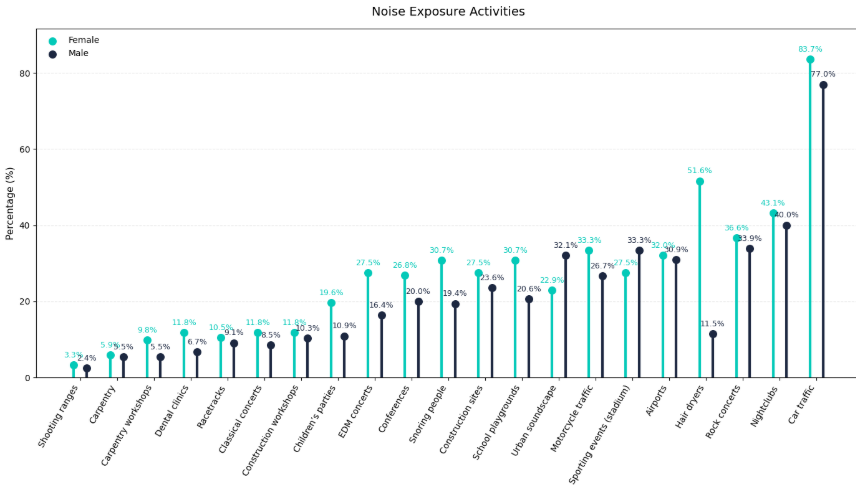
Figure 1 Percentage of noisy activities youths are exposed to by genre (n=319, 1.08:1 male-female ratio).
According to Jo et al. (2024),Click or tap here to enter text. occupational noise prevention and awareness measures begin at the engineering control, followed by administrative control and personal protective training. However, in environmental and recreational contexts, prevention and awareness measures are more complex, as they depend on local regulations for specific activities and the population’s attitude towards specific noise sources, which are more difficult to control, measure and improve.
What Young People Think About Noise?
They exist some qualitative instruments as the Youth of Attitude to Noise Scale Use (YANS), a 19-item reflecting positive and negative attitudes towards noise, depending on the scale values. YANS evaluates four domains; youth culture, concentration, daily noises and intent to improve their environment. Another used instrument is the Hearing Symptom Description (HSD), which aims to measure some auditory symptoms associated with noise exposure such as ear pain, sensitivity, tinnitus. These questionnaires have been used in youths of few Latin American countries to determine their beliefs about noise exposure. In Chile, E. Fuentes-López (2023) et al. concluded, similarly to Bohlin et al. (2011), that behaviors of exposure to auditory risk are a common characteristic of the youths. It has also been reported that men are most likely to reflect positive attitudes to noise exposure than women. Although on our study’s preliminary results show there was no evident difference between men and women on YANS domains as seen in Figure 2. These highlights the gap between noise exposure and perception, enhacning the need of educational interventions.
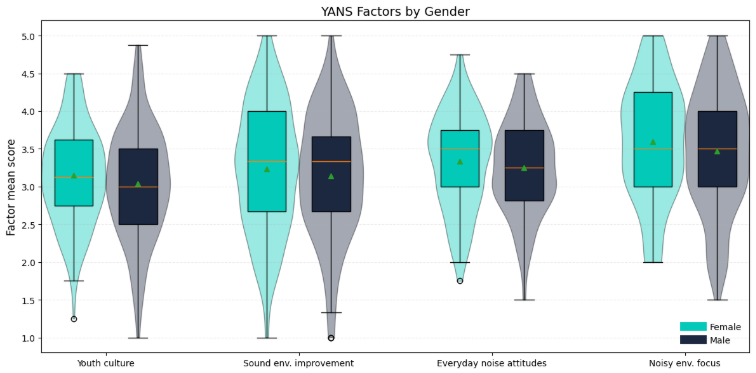
Figure 2 YANS domains by genre in 5-point likert scale (n=319, 1.08:1 male-female ratio).
Do Young People Really Know the Risks?
But do young people really understand the problem? Do they truly know the risks? Even when they are aware of them, are they conscious about the real impact on their lives? And, knowing this information, do they really care?
Many teenagers must think they are far from living the consequences of being overexposed, or may feel like it would never change their lives, underestimating how it would affect in the long-term the way they perceive their environment. Reactions like “I didn´t know the effects of being exposed to high noises like concerts or clubs” or “I had no idea of the impact, I think it is important to know it to prevent any accident”, were common when asking about their instrument’s feedback. Our awareness instrument includes some interactive videos and simulations about hearing loss, tinnitus as some of the risks associated with long term noise exposure. It also highlights the benefits of hearing protection and long-term prevention.. This initiative aims to generate awareness not only by knowing potential effects, but to let them see the role of environmental and recreational noise activities using audiovisual materials as examples. Demonstrative noise soundscapes on the instrument took into account a bibliographic analysis of the sound sources as exemplified on Table 1. References and other soundscapes’ descriptions included on the instrument can be found in https://github.com/sergiomcam/Internoise_1074726_Annexes.
Table 1. Noise soundscapes brief analysis description
| Noise soundscape | Characteristics brief analysis |
| Car Traffic | Environmental soundscape with noise levels from 70 to 100 dBA and peaks over 120 dBA, spanning 50 Hz to 10 kHz, leading to stress, sleep disturbances, and cardiovascular issues. Simulated from a sidewalk perspective with overlapping traffic layers to replicate urban density. |
| Nightclub | Depending on perspective, this soundscape can be recreational, environmental, or occupational. With noise levels from 90-105 dBA and frequencies between 30 Hz to 4 kHz, it causes NIHL, tinnitus, and long-term auditory damage. Built with bass-heavy music and crowd sounds, using EQ, spatial panning, delay, and reverb. |
| Rock concert | Rock concert spaces that reach 102 dBA for 15 minutes, with the highest points exceeding 120 dB(C) and the most prominent energy content between 63 Hz and 4 kHz, contribute to NIHL, stress, and mental fatigue, enhanced by low bass output and necessitating protective sound procedures. |
What Can Be Done? Small Changes, Big Impact
In the absence of adequate policies, regulations and their applications, perhaps the best strategy is to stay informed and inform others. This regulatory gap places greater responsibility on individuals and educational initiatives. Being aware of how exposure time and intensity may affect our mental and hearing performance can help individuals in making better decisions. The approach of developing this instrument does not aim to discourage participation in activities with potential environmental or recreational noise but rather to promote safe exposure. A sample version of the instrument can be found in https://hearingnotion.aidaform.com/noise-awareness-questionnaire. The goal is not to avoid the experiences, but to monitor noise duration and levels. Environmental and recreational noise is poorly regulated in Latin American countries and occurs continuously in our daily lives, even without being noticed. By understanding this, we hope young people become more proactive in caring about themselves and others.
Preventing this can help to improve or at least maintain our hearing, psychological, cardiovascular, neurological and immunological health. In this way it has been found in our pilot tests that young people wearing ear protection, such as ear plugs, is strongly associated with better knowledge and understanding of noise and their consequences, rather that the perceived amount of noise they are exposed to as shown in Figure 3. Thus, more information should be given to youths about what environmental and recreational noise exposure categories are (with clear descriptions), which the main risks are(with examples) and how to prevent them (with practical tips on their daily lives). Practical tips include guidance from the OSHA If you need to raise your voice to speak to someone 3 feet away, noise levels might be over 85 decibels (dBA), NIOSH indicates If you likely have to shout to be heard by someone 3 feet away, noise is reaching 95 dBA, and the WHO recommendation of setting your device’s volume level to no more than 60% of maximum. Recommendations on carrying reusable earplugs if attending or living near concert halls, clubs, stadiums, car races, etc could reduce noise exposure without affecting sound quality, even some noise cancelling earphones can be helpful.
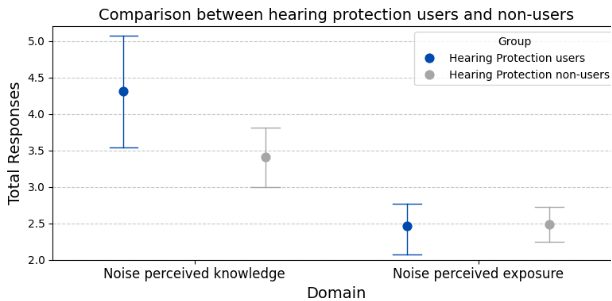
Figure 3 Pilot test of the Hearing Notion Awareness Instrument of perceived knowledge and perceived exposure compared in hearing protection users and non-users (n = 54).
Young people do not always choose which activities to be exposed to, but they can definitely choose how to protect themselves. Generating real consciousness can help society to present less health problems related to hearing and psychosocial issues in the short and long term. We can do a lot for the most exposed population to care about their health today and tomorrow, generating prevention strategies and keeping them aware of noise’s role nowadays.
Author details.
Sergio Mora Camargo is an Engineering Ph.D. student at Monterrey Institute of Technology and Higher Education (ITESM). He holds a B.S. in Music Production Engineering (2019) and an M.Sc. in Engineering (2021). His research focuses on auditory training, acoustic neuroengineering, and computational audiology, with experience leading multidisciplinary research lines within NeuroTechs and AIR research groups. He is also a research collaborator in the Otorhynolaringology Institute at Zambrano Hellion Hospital.
He is a member of the Acoustical Society of America (ASA) and the Audio Engineering Society (AES), where he also serves on the Hearing and Hearing Loss Prevention Committee. He has co-founded companies in audio processing, game development, and auditory health, combining technical innovation with business management.
Sergio has presented at AES conferences, Talent Land, and universities in the US and Spain, and has received travel grants from ASA and I-INCE. His Ph.D. research involves developing neuroaudiological software, auditory discrimination tools, and processing of audio and biosignals. He has completed clinical rotations in otorhinolaryngology centers, gaining experience in audiological assessments, electrophysiology, hearing aid calibration, and cochlear implants.