Global Best Practices in Construction Noise Monitoring
A comparative review of regulations, methodologies, and emerging trends in seven countries
By Dimitri Chamard-Boudet, Christian Fogstad and Dr. Stephen Hambric
Abstract
Construction activity is essential to urban development, yet it remains one of the most common sources of environmental noise complaints worldwide. As cities densify and construction projects grow in scale and complexity, the need for robust, transparent, and effective noise monitoring has never been greater.
Despite this shared challenge, countries approach construction noise in markedly different ways – shaped by local regulations, cultural expectations, and historical practices.
Drawing on insights from expert consultants in United States of America, Canada, United Kingdom, France, Germany, Monaco, and Sweden. This article presents an overview of the regulatory landscape, monitoring methods, and emerging best practices shaping construction noise monitoring today.
Context and Methodology
As an international supplier of environmental monitoring systems, Sigicom has a privileged perspective on the specificities not only of regulatory frameworks but also of the ways in which experts address this challenge in different countries. Noting the lack of literature on this topic, as well as the potential value of understanding how experts elsewhere approach similar challenges, we decided to dedicate a workshop at InterNoise 2024 (Nantes, France) to address this topic.
To ensure objective information for this study, independent experts from each country were consulted and provided with a set of questions, such as: ‘What regulations apply?’, ‘What do typical construction specifications include?’, and so forth. They were asked to focus on the majority of projects and to be as representative as possible. The aim is not to compare or rank the various approaches, but rather to open a broader reflection on these rapidly evolving issues.
Although all approaches ultimately aim to achieve the same objective, comparing different international frameworks broadens the perspective and can provide valuable tools, as well as help disseminate effective best practices.
1. Why Construction Noise Monitoring Matters
Across all markets, experts agree that continuous noise monitoring fundamentally improves construction project outcomes in several ways. It strengthens relationships with neighbors, reduces complaints, minimizes work stoppages, and provides legal protection for project owners. Monitoring also influences on-site behavior; workers become more conscious of noise, scheduling improves, and loud activities are better controlled.
Construction projects specifications now include requirements and limitations to prevent or minimize the discomfort of local residents. Project management in charge of realizing the demolition or construction work commits respecting those rules and regulations. As there may be financial penalties in balance, it becomes natural to control the respect of those terms, and noise monitoring is the only objective judge. But it offers way more than this, and a properly designed monitoring system is providing representative and accurate data. Those data are crucial to identify the incriminated noise sources and design the proper mitigation solution.
In short: if you can’t measure it, you can’t manage it.
2. A Global Patchwork of Regulations
As expected, regulations governing noise monitoring and compliance remain highly localized, and no universal international standard has yet been established. Existing regulatory frameworks range from broadly qualitative guidance documents to highly prescriptive and quantitatively defined limit criteria.
Germany, Monaco and Sweden have a quantitative regulation, including clear guidelines values:
- Monaco (ruling 2021-107) defines a unique admissible LAeq value of 85dB(A) for every situation. It adds one nuance on the Interval duration: 5 minutes when measurement is made in the neighborhood or 15 minutes if done in the construction site.
- Sweden (NFS 2004:15) and Germany (AVV Baulärm) state some guidelines values, adapted to the activity types (e.g: residential, commercial facilities, schools, hospitals, etc.) and different time periods.
Example from Sweden: Guideline value for a residential area on weekdays / daytime, measured outdoor at the facade = 60 dB(A)
NFS 2004:15 also gives some tolerance to adapt to the context or to the exceedance duration (e.g: if exceedance is less than 5 minutes per hour, permitted levels are raised by 10dB)
German AVV Baulärm introduces a specific criterion dedicated to construction noise: the LAFTeq value (Note: LAFT is the Lmax recorded on 5s interval. LAFTeq is the energetic average of the LAFT during day and night periods). This text being from 1970, the guideline values are often below the present noise background levels and get impossible to respect (e.g: LAFTeq < 50dB(A) in area with only residential buildings).
In such cases, the project management team often defers to a precedent‑setting court ruling, which established the limits at 70 dB during daytime and 60 dB at night.
On the other side, France and UK have a more qualitative regulation.
- French Public Health code (Article R1336-10) states how a noise disturbance can be characterized: “No compliance with the construction agreed operations time or the equipment used […] The lack of appropriate precautions to limit noise from the construction site […] Abnormally noisy behavior […]
Those would be complemented in the project specifications with the “Environmentally regulated facility” regulation (Order of 23 January 1997 on the limitation of noise emitted into the environment by installations classified for environmental protection) stating a maximum emergence value in neighbor’s property (5dB(A) on day time and 3dB(A) at night) and maximum noise values on construction site property.
- UK legislation focusses on best practicable means and gives guidance for the determination of noise limits. It is generally based upon the present ambient noise level and an admissible emergence like in France.
In the United States of America, the main national regulation focuses on protecting workers, not members of the public. The Occupational Safety and Health Administration (OSHA) Standard 1910.95 [1] specifies a permissible exposure limit. This is complimented by many local ordinances across the country showing a wide range of approaches, from vague and qualitative in some cities to one of the best known being enacted in New York City in 2012 [2]. This text defines noise limits from construction in neighboring regions, particularly during the night and early mornings.
The Federal Highway Administration (FHWA) Highway Construction Noise Handbook (August 2006) guides state transportation agencies on measuring, predicting, and mitigating highway construction noise, including a user’s guide for the Roadway Construction Noise Model (RCNM). FHWA has also developed a construction noise screening tool (RCNM 1.1) and a construction noise model that is included in all versions of the Traffic Noise Model (TNM). Neither software is required for use on Federal-aid projects; however, they can be used for the prediction of construction noise during the project development, final design, and construction phases.
Table 1 summarizes the applicable regulation in each country, states if noise limits are specified and if project specifications refer to those texts.
| Country | Regulation applicable to construction site noise | Dedicated to construction? | Does it specify noise limits? | Does project specifications refer to local regulations? |
| USA National | OSHA 1910.95 | Yes | Yes, but only for workers | No |
| USA Local | Many, all with varying requirements and monitoring/enforcement | Sometimes | Sometimes | Yes |
| Canada | No national regulation Typically covered in city by-laws | – | – | No – noise monitoring specifications are project based |
| UK | Control of Pollution Act 1974 Local authority policies BS8233: Part 2 (guidance only) | No | Yes – local guidance usually does, CoPa does not | Yes – frequently include projects-based noise limits; particularly on infrastructure projects |
| France | Environment code Article RS571-50(Noise Law 92-1444) Public health code article R.1336-10 Local by-laws “ICPE” 23 January 1997 order | No, but referred to | No, but may state an emergence limit | Yes – however, needs to be complemented with a noise document specific to each project |
| Germany | AVV Baulärm Bundes-Immissionsschutzgesetz (Federal Emission Control, Act) | Yes | Yes | Yes – but noise limits often refer to the “70//60 dB(A)” court rule |
| Monaco | Ministerial Ruling n0 2021-107 from February 2021 Ruling to limit working hours | Yes | Yes | Yes |
| Sweden | NSF 2004:15 Local binding regulations | Yes | Yes | Yes |
3. Where to Measure: A Country-by-Country Comparison
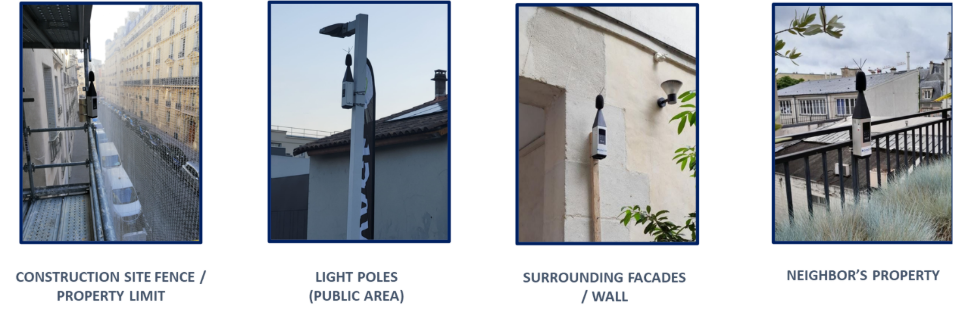
Depending on the limitation criterion (e.g: emergence value at neighbor’s facade, maximum level on site boundaries, etc.), sensor location will be adapted. Countries with guidelines values often try to measure at neighbors’ location.
This has an impact on how the unit can be installed and the performance it needs to have (mounting, autonomy, resistance…).
Most common sensor placement:
- USA: Most often at the site boundary, or sensitive receptors
- Canada & UK: Most often at the site boundary
- France: Site boundary and neighbor’s property (or light poles) are both common
- Germany & Monaco: Prefer measurements at the neighbor’s property, often in front of windows
- Sweden: Façade measurement is the norm
One common point across all markets is that practical on-field constraints – access, safety, urban density – often lead to compromises. In most of the studied areas, a deviation from the initial plan is often accepted as long as the proper correction calculation is performed.
4. What to Measure: Noise Criteria and Parameters
Whether specified by locally applicable regulations or because they arise from the customary practices of local acousticians, the noise criteria vary in all countries. Table 2 below provides the most frequently used noise parameter for construction site monitoring.
| Most commonly measured noise parameter on construction sites | ||||||||
| Country | Long LAEq (Day/Night – Specific time period) | Short LAEq (X sec. min) | Rolling LAEq (X sec. min | Lmax limits | LAFTeq | Spectral (1/1 or 1/3 octave bands) | Statistics (L90 / L10….) | Audio recordings |
| USA (NYC, only) | Yes (Specified as ‘Slow’) | – | No | Yes | No | Yes | – | Yes |
| Canada | Yes (day/night) | Yes LAeq 10 minutes | No | Yes | No | No | Yes L10 | Yes |
| UK | Yes (day/evening/night) | Yes LAeq 5,10 or 15 minutes | No | Yes Nighttime | No | No | No | Yes |
| France | Yes (day/night or multiple periods) | Yes LAeq 5,10 or 15 minutes | Yes | No | No | Yes | No | Yes |
| Germany | Yes (day/night) | No | No | Yes Nighttime | Yes Day/Night | No | No | Yes |
| Monaco | No | Yes LAeq 5 or 15 minutes | Yes | No | No | No | No | Yes |
| Sweden | Yes (day/evening/night) | No | No | Yes Nighttime | No | No | No | Yes |
Despite the differences, several trends emerge:
- LAeq is the most frequent criterion. Long LAeq (day / night,…) enables the project to manage its allowed noise dose along the day, still tolerating some short louder periods – difficult to avoid on those types of projects. This often comes in combination with a Short LAeq to keep a representative picture of the noise level evolution during the day. The interval duration is not fixed but a consensus emerges to consider a LAeq no shorter than 5 minutes.
- Three countries (Germany, Sweden and UK) set limits on Lmax values during night period. This is to consider than even a short noise can be highly disturbing at night time, waking people asleep or creating stress.
- Germany is the only country in this study to have a criterion specific to construction noise (LAFTeq). Local experts acknowledge that this may lead to confusion and make it more difficult to properly assess the levels – as it can’t be compared to noise values on other applications.
- France and Monaco require to monitor 1/3 octave bands as spectral emergence and absence of pronounced tonality – because of their high annoyance effect – need to be verified too.
- Audio recordings is required in all areas. This tool remains the best to determine the noise source and conclude on construction site responsibility.
5. The Data Challenge: Volume, Storage, and Interpretation
Measuring noise 24/7 with inappropriate settings can generate large data quantity that doesn’t always bring project management benefits. Data storage impact, communication cost, data processing, and calculations are among the difficulties that can be created by this downside.
Several factors have a direct impact on the quantity of data: measured criteria, interval duration, hardware used, threshold for audio recording, etc.
The number of audio recordings is certainly the main reason for extreme situations with several GB of data processed every month. One of the reasons could be that the audio recording trigger value is often not specified in the project specifications. In some countries, consultants would use the LAeq limit to trig a recording – potentially leading to hundreds of audio clips per day.
- France and Canada may produce hundreds of audio clips per day
- Monaco, with its generic high limit of 85dB(A), generates fewer alerts
- A single sound level meter can exceed 10 GB of data per month
Consultants note that reviewing every audio file becomes impossible on large projects. This is driving rapid adoption of AI-based audio classification and smarter alerting systems.
6. The Impact of Monitoring on Project Outcomes
Experts from all the countries studied agree on the benefits provided by noise monitoring and consistently report the following gains:
- reduces complaints
- prevents unnecessary work stoppages
- improves neighbor relations
- supports transparent communication
- helps verify or dismiss noise related claims
- encourages quieter onsite behavior
For all those reasons, monitoring is no longer seen as a burden and is increasingly viewed as best practice that simplifies project management.
Field monitoring also provides the required input data to recalibrate the noise calculation models and helps design the required treatments.
7. Emerging Trends and Innovations
Although noise monitoring around construction sites has existed for several decades in some countries, recent advances in the technologies employed, together with the evolving expectations of both experts and residents, are driving rapid evolution within the entire sector.
Key Trends
- Web platforms enabling real-time public communication
- More sophisticated noise limits with multiple time periods and variables to adapt to the specific contexts
- Battery optimized, wireless monitoring stations for long-term deployments with minimal on-site maintenance
- AI-powered audio recognition to classify noise sources
These innovations are reshaping how consultants, contractors, and authorities manage construction noise. The cost reduction of the monitoring stations, and their improvement in terms of installation capacities – autonomous, wireless… – allows to increase the number of measuring points on each project. This helps get a clear picture of the situation and measure it at every sensitive point.
8. Conclusion
Construction noise monitoring is now widely recognized as a standard practice at the global scale. Despite significant variations in regulatory approaches, ranging from qualitative recommendations to strict quantitative limits, the core objectives are shared:
- protect communities
- support responsible construction
- ensure transparency
- reduce conflict
- improve project efficiency
Every country relies on its own methodology, shaped by local context and expectations. Yet the global trend is clear: better data, better communication, and better technology produce better projects!
As cities continue to grow, the industry will benefit from ongoing collaboration, shared best practices, and continued innovation in monitoring tools and methodologies.
Bibliography
| Country | Reference Standard / regulations |
| USA | Occupational Safety and Health Administration (OSHA) Standard 1910.95 [1] |
| Canada | Chapter 591 of the City of Toronto Municipal Code |
| UK | The Control of Pollution Act 1974: Sections 60 and 61 BS5228: Code of practice for noise and vibration control on open construction site – Part 1 Noise |
| France | Noise Law n°92-1444 from December 1992 Public Health code Order of January 1997 relating to the limitation of noise emitted into the environment by installations classified for environmental protection |
| Germany | Bundes-Immissionsschutzgesetz – Federal noise Immision Act AVV Baulärm (August 1970) |
| Monaco | Ministerial ruling 2021-107 from February 2021 relative to construction noise |
| Sweden | Swedish Environmental Protection Agency’s general advice on noise from construction sites (NFS 2004:15) |
1. https://www.osha.gov/laws-regs/regulations/standardnumber/1910/1910.95
2. Thalheimer, E., and Shamoon, C., “Understanding and Complying with the New York City Construction Noise Regulation,” Proceedings of Inter-Noise 2012, New York City, 2012.
3. Mydlarz, C., Shamoon, C., and Bello, J.P., “Noise Monitoring and Enforcement in New York City using a Remote Acoustic Sensor Network,” Proceedings of Inter-Noise 2017, Hong Kong, 2017.
4. Sounds of New York City (SONYC) resources website: https://wp.nyu.edu/sonyc/resources/
Dimitri Chamard-Boudet
- General Manager for Sigicom France, 2015 to present
- Acoustic and Vibration consultant in dBVib Consulting (2010 – 2015)
- Master’s degree in Acoustics and Vibrations (University of Lyon – France)
Christian Fogstad
- General Manager for Sigicom Inc., 2012 to present
- Master’s degree in Structural Engineering (University of Wyoming)
Dr. Stephen Hambric – USA
- Consultant in vibration and acoustics, flow induced vibration, signal processing, and noise control. Retired Professor from the Penn State Graduate Program in Acoustics and former Director of Penn State’s Center for Acoustics and Vibration (CAV)
- Specialist in architectural acoustics and noise impact studies.
Blake Lucas – United Kingdom
- Acoustic Consultants Ltd, United Kingdom
- Specialist in architectural acoustics and noise impact studies.
Nathan Gara – Canada
- HGC Engineering, Canada
- Specialist in acoustical consulting and environmental noise control.
Pascal Guittat – France
- SIXENSE Engineering, France
- Expert in infrastructure monitoring and geotechnical instrumentation.
Robert Braun – Germany
- Peutz, Germany
- Consultant in building acoustics, environmental noise, and vibration analysis.
Patrice Arnoult – Monaco
- Bureau Veritas, Monaco
- Senior advisor in environmental compliance and industrial risk management (retired in 2025)
Daniel Lindmark – Sweden
- Efterklang, Sweden
- Leader in sound design, acoustic engineering, and environmental assessments.