Racket Sports and Environmental Noise: Assessing and Predicting Impulsive Noise from Tennis, Padel and Pickleball
By Alfons Geltinger, M.Eng.
When Trends Meet Urban Development – Drivers Behind the Growing Demand for Acoustic Assessments of Racket Sport Facilities
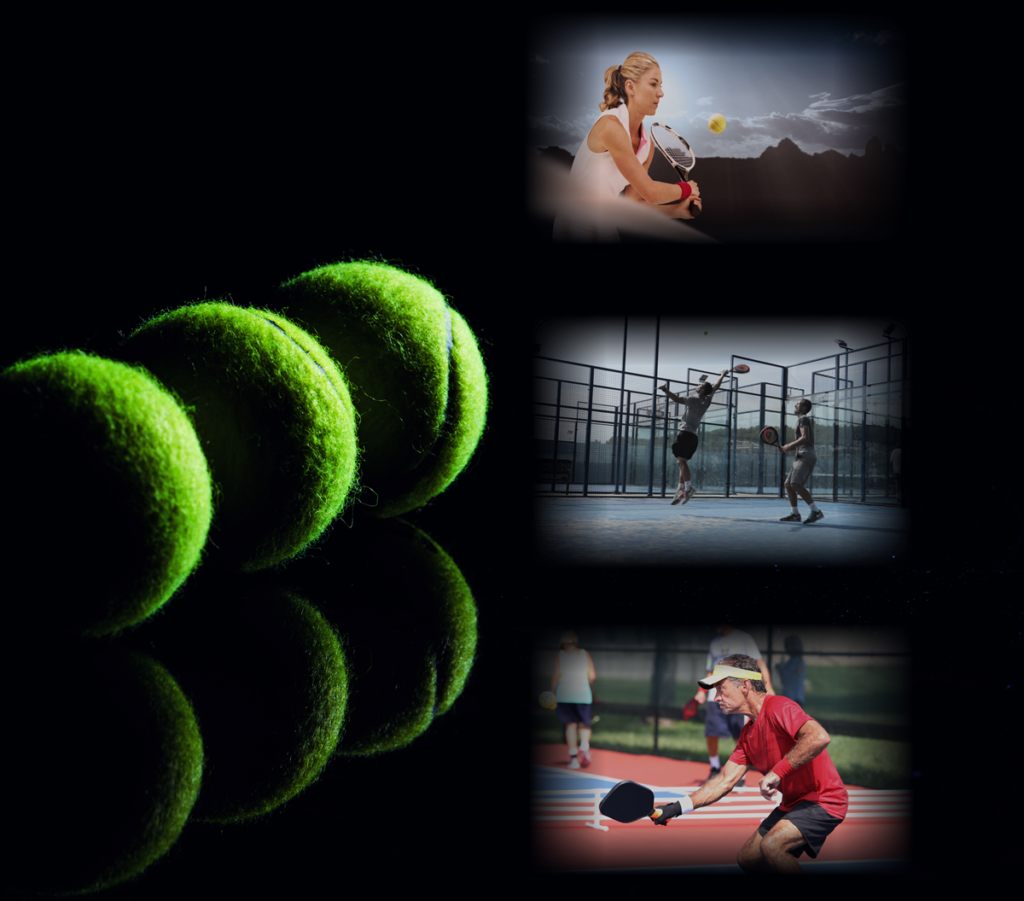
Padel and pickleball are among the fastest-growing racket sports worldwide. As new facilities are developed, often in urban or suburban areas, residential and other noise-sensitive uses are frequently located in proximity to the courts. At the same time, existing tennis facilities are being expanded or converted, for example, by adding additional courts. Measurements show that, under typical operating conditions, padel and pickleball can produce higher sound emissions than tennis. In particular, the impulsive nature of ball-strike noise can lead to acoustic conflicts. As a result, noise assessments are often required during site selection, permitting, and the design of mitigation measures.
A Practical Gap in Assessment and Prediction
For tennis, established emission models and assessment procedures have been available for many years. For padel and pickleball, however, suitable emission data and a consistent approach for multi-court or mixed operation were not previously available. This gap complicated reliable noise predictions as well as the targeted design of structural and operational mitigation measures.
What Makes These Sounds Special? Impulsive Ball-Strike Noise
Noise from tennis, padel and pickleball is primarily characterized by ball-strike events. The impulsive character of these sounds is clearly visible in the level–time history, as illustrated in the diagram below using the LAFmax signal measured at an active padel court. Individual strikes generate pronounced level peaks that differ significantly from continuous or steady noise sources.
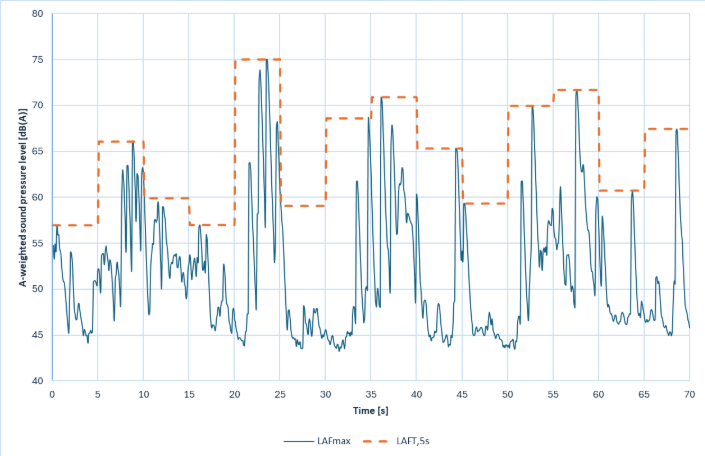
Figure 1. Level–time history of ball-strike noise at an active padel court showing LAFmax and LAFT,5s evaluation.
Assessment of Impulsive Noise
Environmental noise assessment internationally often follows the general principles of the ISO 1996 series. For a given receiver location, an A-weighted equivalent continuous sound level is determined over defined assessment periods and, where necessary, adjusted for specific noise characteristics.
For impulsive sounds, ISO 1996-1 provides general corrections for impulsiveness. In practice, however, the degree of impulsive character varies significantly depending on the sport and the number of courts operating simultaneously. Event-based evaluation methods therefore, provide a particularly illustrative approach. Measurement studies from the United States provide an example of an event-based evaluation approach. In a NOISE-CON 2023 study on pickleball, LAFmax was evaluated in consecutive 5-second windows, and the maximum value in each window was taken as the representative value for that entire 5-second interval. A comparable principle has been established in Germany for approximately 30 years through the 5-second maximum level procedure (LAFT,5s); see the LAFT,5s trace in the diagram. With appropriate emission data, the tennis-based method (VDI 3770) can be extended to padel and pickleball, including multi-court and mixed operation.
Emission Models for Tennis, Padel, and Pickleball
For predicting impulsive racket sport noise, sport-specific emission parameters are used to represent both peak levels and event frequency. LWAFmax describes the maximum A-weighted sound power level of a single ball strike. ksp represents the fraction of 5-second intervals in which at least one impulse from the respective source occurs. From these parameters, a time-weighted equivalent emission value LWAT,eq can be derived, representing the average emission contribution of one active court.
Table 1. Sport-specific emission parameters for tennis, padel and pickleball
| Sport | Sources per Court | LWAFmax,i (ball strike) | ksp | LWAT,eq per source |
| Tennis | 2 | 95 | 0.3 | 90 |
| Padel | 1 | 100 | 0.5 | 97 |
| Pickleball | 1 | 102.5 | 0.5 | 99.5 |
The 5-Second Maximum Level Procedure for Impulsive Racket Sport Noise
Assessment is performed in 5-second time windows and reflects two key effects:
- Impulses of one source occur only in a fraction of the time windows (e.g., rally pauses, side changes), described by the sport-specific time share ksp.
- Within a 5-second window, only the dominant impulse is considered, multiple impulses within the same window are not energetically summed.
For a given receiver location, sources are ranked according to decreasing relevance. The ranking is obtained from a preliminary calculation in which each source is assigned its maximum sound power level LWAFmax,i and its contribution at the receiver is determined. The effective time share is then assigned stepwise:

The corresponding level correction is:
and the time-weighted sound power level of source n becomes:
The resulting emission values are then propagated to the receiver using the selected sound propagation model and energetically summed.
Simplified Approach
As a simplified screening approach, each source can be assigned its equivalent emission value LWAT,eq from Table 1, without further correction. Because this approach does not account for the 5-second time-window logic or the temporal exclusivity of impulses, it tends to overestimate sound levels in multi-court operation.
Example Application
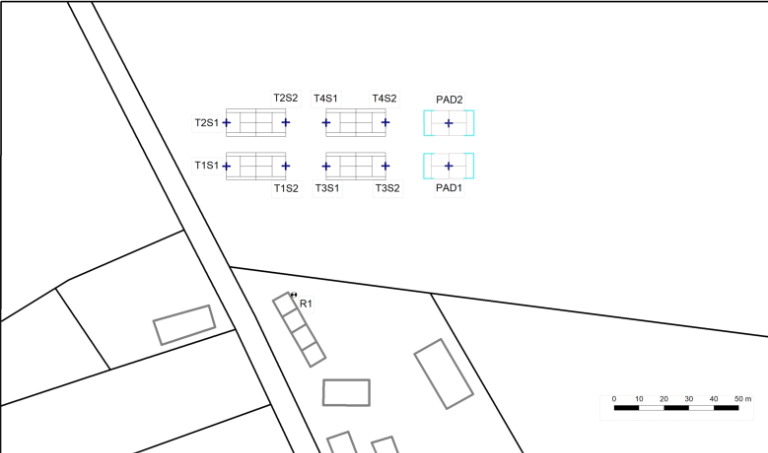
Figure 2. Example multi-court facility and receiver location R1 used for applying the 5-second maximum level procedure.
The assessment principle is applied to a facility with four tennis courts and two padel courts (see the figure above). Receiver R1 is evaluated during a period with simultaneous operation on all courts. Sources are ranked according to their relevance at the receiver. Within each 5-second interval, only the dominant impulse contributes fully, while lower-ranking sources are considered proportionally. For this configuration, the equivalent 5-second maximum level is approximately 50 dB(A). Using the simplified approach, where emissions are energetically summed without time-window logic, the rating level at R1 is overestimated by more than 4 dB. The example shows that while the simplified approach may be suitable for preliminary screening, it is only of limited use for defining mitigation measures or operational restrictions in multi-court operation.
Implementation in Prediction Software
Because source ranking and effective sound power levels depend on the receiver location, manual calculation becomes impractical for multiple receivers. In CadnaA, a quality-assured software implementation in line with ISO/TR 17534-3, the existing “tennis source” object has therefore been extended with emission data for padel and pickleball. After selecting the sport type, the software automatically performs source ranking, time-share allocation, and the corresponding sound power level corrections, followed by noise prediction for individual receivers and grid calculations, enabling efficient and reproducible assessments.
Special Case: Roofed Facilities and Complex Geometry
For complex geometrical conditions, particularly roofed courts or configurations with horizontal or inclined elements, standard environmental noise models such as ISO 9613-2 may not adequately represent multiple reflections between ground and roof surfaces. In such cases, an appropriate propagation model that can account for multiple reflections in such geometries (e.g., an energy-based particle method implemented in specialized tools such as CadnaR) may be required. The event- and time-share-based assessment method described above remains applicable regardless of the propagation model used.
Conclusion:
The expansion of racket sport facilities is increasing the need for acoustic assessments. The critical factor is the impulsive, event-driven character of ball strikes, which varies with sport type and the number of simultaneously active courts. Extending the established 5-second maximum level procedure (VDI 3770) from tennis to padel and pickleball enables consistent representation of impulsive evaluation levels in multi-court and mixed operation. Simplified equivalent-level approaches may lead to systematic overestimation and are therefore better suited for screening than for defining mitigation measures. Implementation in prediction software allows automated, reproducible calculation of source ranking, time-share allocation and propagation, significantly reducing effort in practical assessments.
Alfons Geltinger, M.Eng. is a Senior Software Consultant at DataKustik GmbH, specializing in environmental noise, indoor, and building acoustics. He supports consultants and authorities worldwide in the application of prediction models for environmental noise assessment and works closely with the development team on the implementation of new software capabilities.