Road Traffic Noise as an Environmental Reality in Algerian Cities
By Dr. Boulemaredj Ali, Dr. Meribai Amine Mehdi
Cities are designed to allow for mobility so that industries can function, people can commute, and goods can move around. Traffic is a sign of economic vitality, but when mobility devolves into uncontrollably loud noise, the city starts to lose something vital: tranquility.
Road traffic noise is frequently considered as irritation; it is actually a persistent environmental contaminant. Although it doesn’t leave any outward signs like air pollution, it permeates homes, schools, and hospitals on a daily basis. Environmental noise is a significant public health concern, according to the World Health Organization, which also links prolonged exposure to auditory and non-auditory effects. This problem has gotten worse in Algeria due to the country’s rapid urbanization and rising car ownership.
Legal Framework Background
Since the 1980s, Algeria has created a significant body of laws pertaining to public health and the environment. Road traffic laws contain clauses pertaining to vehicle compliance, and executive decrees specify the highest permissible noise levels. More recently, state rulings prohibiting the movement of loud sports cars and big-engine motorcycles at night were enacted by local governors.
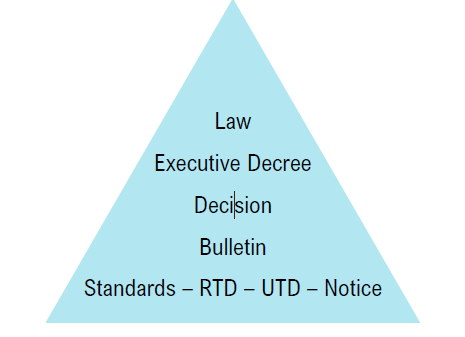
Figure 1. Regulatory texts hierarchy in Algeria (Authors)
A number of wilayas addressed public complaints in 2023 and 2024, like the state Decision No. 2485 and 2486 in Annaba that targeted sports vehicles and motorcycles larger than 125 cm³, especially those with modified exhaust systems. As a deterrent, temporary impoundment was implemented. These actions send a clear message that excessive noise is no longer acceptable in urban settings. However, the crucial question still stands as to whether reactive limitations by themselves can result in long-lasting change.
Table 1. Overview on Algerian national regulation on road noise control
| Regulation title | Source | Date |
| Executive Decree No. 93-184 relating to noise emission thresholds | JORA, No. 50 | Published in July 1993 |
| Law No. 01-14 concordant with the organization, security and policing of road traffic | JORA, No. 46 | Published in August 2001 |
| Law No. 03-10 relating to environmental protection within the framework of sustainable development | JORA, No. 43 | Promulgated in July 2003 |
| Executive Decree No. 03-410 setting out thresholds for emissions of smoke, toxic gases and noise from motor vehicles | JORA, No. 68 | Published in 2003 |
| Executive Decree No. 04-381 on road traffic rules | JORA, No. 76 | Published in November 2004 |
| Law No. 17-05 amending and supplementing Law No. 01-14 of August 2001, corresponding to the organization, security and policing of road traffic | JORA, No. 12 | Promulgated in February 2017 |
| State Decision No 1123 | Wali of Algiers | Published in 23th April 2023 |
| State Decision No 2485 | Wali of Blida | Published in 23th April 2023 |
| State Decision No 2586 | Wali of Annaba | Published in 23th April 2023 |
| State Decision No 1497 | Wali of Setif | Published in 20th April 2024 |
Reactive Control Limitations
Extremely noticeable behaviors like abrupt acceleration and modified exhaust systems intended to enhance sound are addressed by nighttime bans. Road traffic noise, however, is not limited to these cars. The overall sound burden is increased by aggressive driving, loud car audio systems, heavy trucks passing through residential areas, and poorly maintained buses.
Another challenge is measurement. Without conducting a systematic on-site decibel verification using calibrated sound level meters, the term “noisy vehicle” is frequently used. Thus, legal robustness and consistency are compromised when enforcement relies heavily on auditory judgment.
Road noise is also a continuous environmental exposure shaped by traffic density, vehicle speed, road surface materials, and urban layout. Restricting circulation during specific hours may reduce peak disturbance, but it does not resolve daytime exposure or structural planning issues such as major traffic corridors running alongside dense housing.
From Implementation to Prevention
The response must go beyond fines if road traffic noise is considered an environmental pollutant. Better planning, measurement, and prediction are necessary for prevention.
Predictive analysis is now more widely available thanks to digital online tools, like Environmental calculator RIGO, CoRTN and the NZTA road noise calculator, which permit planners to make sound level estimates based on distance, surface type, traffic volume, and speed. These tools are frequently open-access and reasonably friendly-user. By incorporating them into municipal planning, authorities would be able to foresee acoustic effects prior to the implementation of infrastructure decisions.
Additionally, noise mapping ought to become standard procedure. Targeted action, such as lowered speeds, better road surfaces, or clever barriers, is made possible by identifying acoustic hotspots. Lowering speed limits in residential areas can greatly reduce perceived annoyance and overall exposure, according to international experience.
Systems for inspecting vehicles are equally important. One of the most severe causes of peak noise events is still illegal exhaust modifications. Instead of responding after a disturbance occurs, strengthening acoustic compliance within routine technical inspections would address the issue at its root.
Learning from Innovative Monitoring: The Medusa Example
Technology can increase the accuracy and fairness of enforcement. Bruitparif created “La Méduse,” an acoustic monitoring system, in Paris. This gadget locates and detects extremely noisy cars in real time by combining cameras and directional microphones. The source can be accurately identified when predetermined thresholds are exceeded.

Figure 2. La Méduse device deployed in Ile-de-France municipality (BruitParif)
Subjectivity would be decreased in Algerian cities by using similar strategies. Automated acoustic detection systems have the potential to assist in identifying offenders and supplement conventional patrols. Especially in cities with a shortage of human resources, such technology increases transparency and makes enforcement more data-driven.
The Rise of Artificial Intelligence
Artificial intelligence is having a wider effect on how we manage the environment. AI systems can look at big data sets that include traffic flow, vehicle types, speed, weather, and the shape of the city to help control noise. Machine learning models can predict when, where and how much noise peaks are likely to happen by looking at past patterns.
Because of this ability, the authorities can expect problems instead of waiting for complaints. AI-driven noise maps can update dynamically instead of remaining static for years. This flexibility is very important in cities that change quickly.
When combined with acoustic sensors, AI can tell the difference between normal traffic noise and unusual sounds, like modified exhaust bursts or very fast acceleration. It gives monitoring systems like the Medusa model more analytical intelligence. Urban planners can also use AI simulations to see how changes like slowing down traffic or changing its route will affect the sound before they happen. Regulation is not replaced by artificial intelligence, but it makes it stronger by making it more accurate and efficient.
Bridging Law and Urban Reality
Algeria’s laws show that they know that noise from vehicles on the road is a public issue. Recent decisions by the state show that they are listening to people, but there is still a gap between what the law says and what people hear every day.
To close this gap, we need measurable standards, calibrated equipment, predictive tools, new ways to monitor sound, and better ways to include sound criteria in city planning. Web-based calculators can help in predictions. Automated systems can empower the enforcement. AI can aid with planning for the long term, and more thorough vehicle inspections may stop serious violations.
Noise from transportation means doesn’t have to be a cost of development, it can be measured, changed, and predicted gradually. To manage it well, we need to move from isolated restrictions to a preventive and data-driven approach. As a whole and without blocking mobility, urban tranquility can be achieved and public health won’t be compromised in Algerian cities.
Author details
1 Dr. Boulemaredj Ali, architect with a Master’s degree in Architecture and Construction (2017), and affiliated research professor (2023) in the Department of Architecture, Faculty of Earth Sciences, University of Badji Mokhtar Annaba. Since completing his PhD [2018–2023] in architecture, specializing in sustainable housing and construction knowledge, he has been passionate about architectural and environmental acoustics, as well as the fight against noise pollution in urban areas. Author of multiple publications.
² Meribai Amine Mehdi, architect with a Master’s degree in “Urban Design” in 2018 from the University of Constantine 3, then doctoral student affiliated with the Department of Architecture, Faculty of Science and Technology, University of May 8, 1945 in Guelma. He is enthusiastic about urban geography, geographic information systems (GIS), and urban mobility. He recently received his doctoral degree in 2026.