Urban Noise Management in Ecuador: From Citizen Complaints to Noise Maps
Noise is easy to ignore by day. At night, it becomes personal. Ecuador’s 2015 rules opened the door to noise mapping. Now maps must become action.
By Luis Bravo-Moncayo
A city is supposed to soften at night. The light changes, voices fade, and the body prepares for rest. Yet in many Ecuadorian neighborhoods, the calm never fully arrives. A motorbike accelerates outside. A bus brakes hard at the corner. A horn cuts through the dark. Sleep becomes a struggle.
When this happens repeatedly, people adjust. They close windows and switch rooms. They wake up tired and carry it into school and work. And, sooner or later, someone reaches a limit and decides to report it.
That is how noise management has often worked in Ecuador: complaint, inspection, warning, and sometimes a fine1. This work matters, because it protects people in the moment. Complaints are not a map of exposure. They show where frustration is loudest, not where risk is highest. They also depend on who feels safe to complain, who has time, and who expects a response.
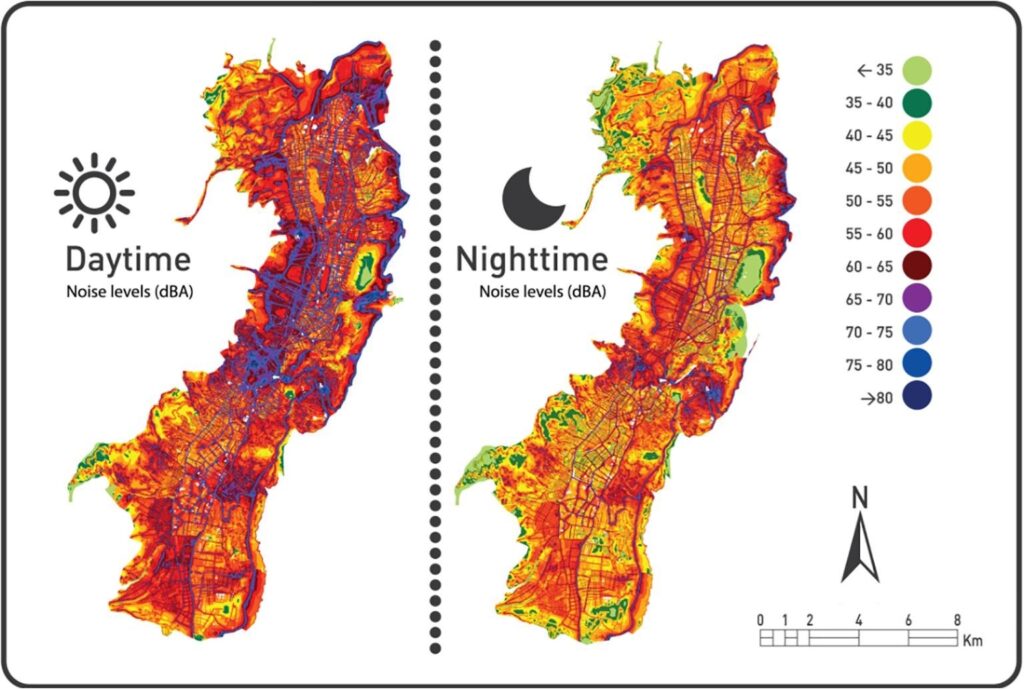
So, Ecuador has been building a second lane alongside enforcement: noise mapping. Mapping turns sound into a living landscape. It shows where noise concentrates, where quiet exists, and how many people are exposed specially at night, when the cost is paid in sleep.
A Decade of Rules—And Too Many Noisy Nights
Ecuador’s national framework for environmental noise has been in force since 2015. It does more than set permissible levels. It also assigns responsibility. In particular, it places the duty to elaborate environmental noise maps on municipal governments once they reach a population threshold. It also frames the first stage around the main roads, where traffic often dominates.
Ten years is enough time to learn a hard lesson: a rule is not the same as a system. Rules define limits and methods. A system adds routines, capacity, budgets, and follow-up. It makes progress repeatable, even when administrations change. That is why the question is shifting from “Should we map?” to “How do we map, act, and validate outcomes?”
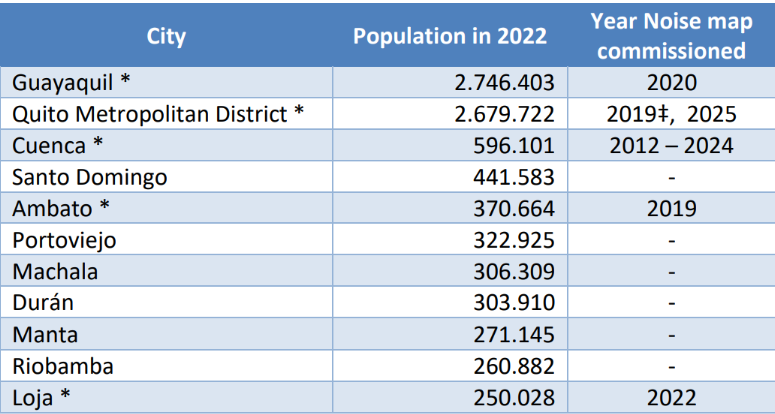
Table 1 lists municipalities above 250,000 inhabitants. It also shows that the country already has local experience to learn from.
Table 1. Municipalities above 250,000 inhabitants (Census 2022)
What a noise map really is
A noise map is not just a “pretty picture.” It is a decision tool. Because it is spatial, it can connect three issues: health, mobility, and economics.
In Ecuador today, three approaches appear most often, and they are increasingly combined. Some projects use predictive traffic modelling. They estimate noise across a grid using road data, traffic volumes, speeds, and the share of heavy vehicles, and then they check results with field measurements. Other projects start from measurements at many points and use GIS methods to estimate values between locations. A newer approach adds sensor networks, so trends can be tracked over time. That makes it easier to ask a question that matters to residents: did the street become quieter after an intervention?
Health begins at night
Noise becomes urgent when it enters the home, and it becomes serious when it enters the night. Night-time noise disrupts sleep and recovery. Attention and learning suffer. Mood changes. Safety can suffer. Over time, health risks rise.
That is why mapping should not stop at decibels. It should translate sound into exposure: who lives above key thresholds, and how many people are likely to face high annoyance or sleep disturbance. Once a city can see those patterns, the debate changes. It moves away from “who is complaining?” and toward “who is being exposed?”
Mobility has a sound
The hopeful part of this story is that urban noise is not fate. It is design, behaviour, and policy.
Traffic noise is shaped by more than vehicle counts. It depends on stop-and-go flow, heavy vehicles, speed, road surface, and street geometry. In dense corridors, reflections can amplify what people hear at street level and inside homes. Because of this, mobility policy can deliver a noise dividend.
Speed management near residential areas can reduce peaks and improve safety. Heavy-vehicle routing or time windows can protect sleep. Smoother intersections can reduce harsh acceleration and braking. And stronger public transport can reduce vehicle volume in sensitive areas. In short, noise can become a mobility performance metric.
2https://doi.org/10.1016/j.cstp.2018.12.006
3https://jcaa.caaaca.ca/index.php/jcaa/article/view/4155 4https://ierse.uazuay.edu.ec/proyectos/mapaRuido/
Quiet has economic value
Noise is an urban externality. The person generating it is not always the person paying its cost. The cost shows up as stress, poor sleep, and reduced productivity. It also shows up in health.
Ecuador already has evidence using willingness-to-pay methods, showing that resident’s value noise reduction. This does not mean quiet should become a luxury. Rather, willingness-to-pay evidence —one estimate suggests roughly US$12 per household per year to reduce traffic-noise annoyance— can help decision-makers compare options and justify budgets, especially where exposure is highest.
Strengthening the 2015 framework: from rules to a system
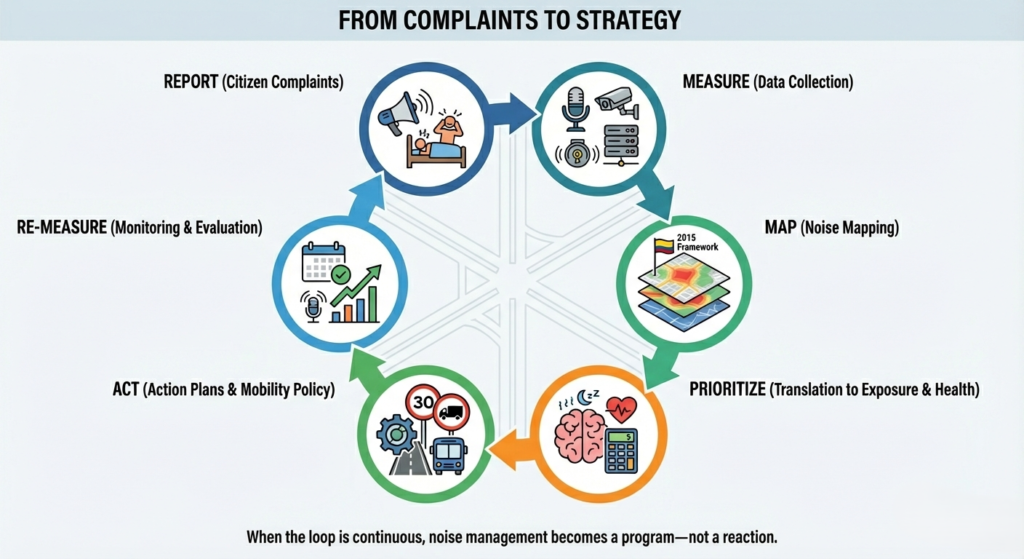
Ecuador’s next challenge is to move from reactive enforcement toward a preventive system. Important gaps remain in standardization, enforcement consistency, and technical training. For that reason, noise maps should not become an end in themselves. They should trigger measurable action plans.
In the near term, Ecuador needs a unified national approach. The goal is practical: align planning across cities, standardize technical instruments, and strengthen coordination between national and local authorities. At the same time, capacity must grow. Training pathways, and clear protocols are essential, especially when decisions affect homes, schools, and hospitals. Transparency and public participation should be built in from the start.
Equally important, the map-to-plan conversion should become legally obligatory. Action plans would set priorities, budgets, timelines, and responsible institutions, and they would be reviewed on a regular cycle. They should include a catalogue of measures—from quieter pavements and acoustic screens to time limits for noisy activities—plus health and social impact evaluation and shared financing.
Finally, Ecuador’s next mapping cycles should broaden their scope. Traffic is a sensible starting point. Yet updates should increasingly represent other dominant sources, including industrial activity and leisure and entertainment, so the map reflects the lived soundscape of a city, not only its roads.
If Ecuador strengthens these pieces, the story becomes coherent. Enforcement protects people today. Mapping protects people tomorrow. And action plans, updated and monitored, can help the city give the night back to its residents.
5https://doi.org/10.1016/j.landusepol.2019.104059
6https://doi.org/10.1016/j.cstp.2017.08.003