International Guides to Measuring Heavy/Hard Impact Noise and the Need for Standardization in North America
By Wilson Byrick, BESc., VP Engineering Services, Pliteq, wbyrick@pliteq.com

Disturbing noise and vibration caused by fitness activities is a key design consideration for acoustical engineering professionals. Impact noise classified as heavy/hard impact can be particularly difficult to mitigate. While most acoustical design firms have procedures in place to complete site testing and make recommendations, there is no standard to follow. This lack of standardization can result in conflict between owners and tenants and the engineers that represent them. In this article, I will attempt to summarize the international guidelines that exist to highlight the need for standardization in North America.
Association of Australasian Acoustical Consultants (AAAC) Guideline for Acoustic Assessment of Gymnasiums and Exercise Facilities
The AAAC guidelines were developed with the objective of establishing clear procedures for the measurement, prediction, and assessment of noise and vibrations. These guidelines are not regulatory, but are intended to serve the purpose of test data being consistent, accurate, and not misleading. There exists a guideline for Gymnasium and Exercise Facility assessment.
While there is no standard weight or drop height outlined within this guideline, the testing procedure is recommended to simply be consistent with the planned activities in the space. A frequency range of 31.5 – 250 Hz octave bands is considered, A-weighting is applied and a minimum of four drops are suggested. The fast max sound pressure level measured at these four octave bands is converted into a single number rating by applying a logarithmic average (Equation 1)

Acceptable sound pressure levels due to exercise-related vibration-borne sound, for residential and non-residential applications are indicated below.
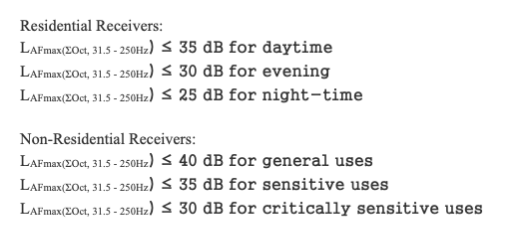
Within this guideline, daytime is defined as 7:00 am to 6:00 pm, evening, 6:00 pm to 10:00 pm and night-time 10:00 pm to 7:00 am (8:00 am on Sundays and public holidays). Establishing a receiver as general, sensitive, or critically sensitive requires justification from an acoustical consultant.
IOA/ANC – ProPG Gym Acoustics Guidance
Professional Practice Guidance on gym acoustics (ProPG GAG), is a document developed in the United Kingdom by the Institute of Acoustics (IOA), the Association of Noise Consultants (ANC) and the Chartered Institute of Environmental Health (CIEH) to provide a standardized approach for assessing the acoustic impact of gymnasiums, fitness centers, and other exercise spaces. The guidance aims to help manage noise and vibration, assess new or existing gym locations, and resolve noise complaints by offering a consistent methodology for the design and assessment of such facilities.
The International Organization for Standardization developed Noise Rating (NR) curves to set a standard for an acceptable sound pressure level in receiving spaces due to external sound. Noise Rating is determined by comparing the sound pressure level of a data set across octave bands for the frequency range of 31.5 – 8000 Hz with the NR curves. These are like the NC curves widely used in North America but allow higher levels at low freque.
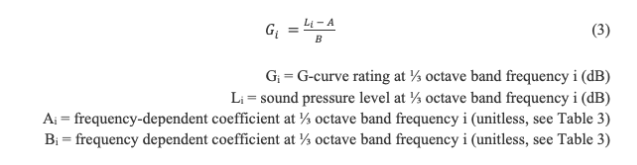
The ProPG guideline was developed based on the authors’ interpretation of said curves, to form G-curves, which are more appropriate for fitness-related noise as well as higher resolution by using one-third octave bands across the same frequency range. The overall rating for an assembly is the highest individual rating of the data set (Equation 3). The target ratings for various receivers are presented in Table 3.
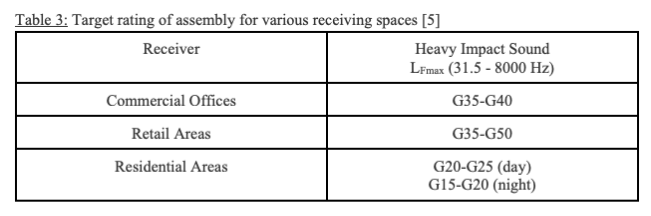
Regarding the testing procedure, the Guide presents two methodologies: Method One involves dropping a 20 – 35 kg spherical impactor from a height of 500 mm, and method 2 testing is like AAAC, where the goal is to measure realistic anticipated/existing resulting noise levels that is representative of the proposed gym activity in the space.
ASTM WK90900
While ASTM has not published anything, there is work being done and sub ballots being voted on. A draft of an ASTM measurement standard is in process, the Standard Guide for Field Measurement of Impact Sound and Vibration Transmission Through Floor-Ceiling Assemblies and Associated Structures When Using Heavy-Hard Impact Objects. It specifies measuring the fast max sound pressure level in a receiving space across a minimum frequency range of 50 – 500 Hz one-third octave bands. The procedure requires that a spherical impactor at a mass of 3, 7.26, or 22.68 kg is dropped from a height of 50 cm.
There currently are no criteria or single number rating derived from this method to assess the performance of an assembly. It is anticipated that a separate standard will be developed to assign single-number ratings to the performance of these assemblies and associated criteria.
The need for standardization
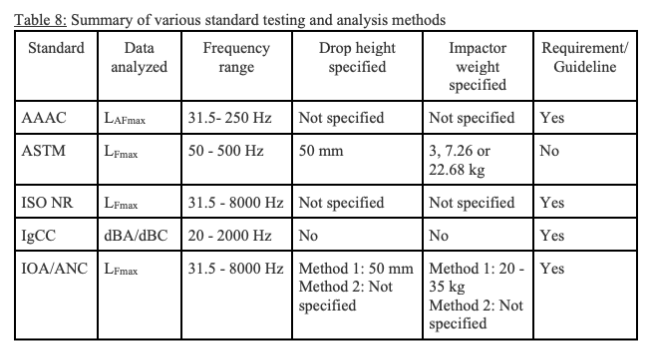
Acoustical engineers the world over design buildings with heavy/hard impact noise and vibration in mind. Some of the guidelines presented in this article also have information related to vibration which was not addressed here. Numerous groups including the International Green Building Council and ISO noise regulations stipulate noise levels not to be exceeded in receiving spaces. Perhaps these can form a basis of recommendations for performance criteria resulting from standardized heavy/hard impact testing defined by the proposed ASTM WK90900 procedure. A summary table of all the guidelines and criteria relevant to the topic is included below.
More information regarding this article can be found in the NoiseCon 2024 published paper entitled Applying the Association of Australasian Acoustical Consultants (AAAC) guideline for acoustic assessment of gymnasiums and exercise facilities to field measured heavy hard impact data. (Byrick, Edwards 2024)