Towards quieter wind turbines by perception-driven design
By Roberto Merino-Martinez, Faculty of Aerospace Engineering, Delft University of Technology, the Netherlands. Email: r.merinomartinez@tudelft.nl
Introduction
Wind energy is one of the cornerstones of the global energy transition. Its installed capacity continues to grow steadily, both onshore and offshore, and so does the physical size of the turbines themselves: rotor diameters exceeding 200 m (roughly two football fields!) and hub heights above 150 m are no longer exceptional. Larger rotors capture more energy and, in general, reduce the cost per kWh, but they also raise a legitimate question for the acoustics community:
“What does this upscaling trend mean for the noise experienced by the growing number of people living near wind farms?”
A relatively quiet source, but a large impact
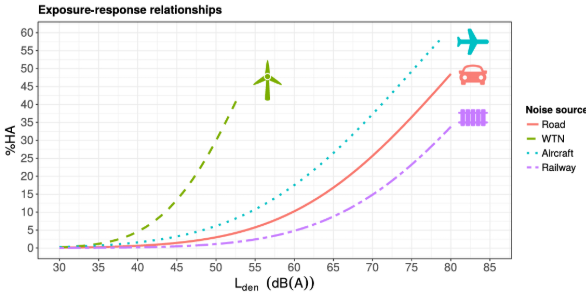
Figure 1– Comparison of exposure-response relationships for people highly annoyed by road, railway, aircraft, and wind turbine noise (WTN) [1].
Compared to aircraft or road traffic, wind turbines are relatively quiet sources in terms of sound pressure levels. Paradoxically, however, they generate a disproportionately large annoyance response [1], see Fig. 1. Whereas direct adverse health effects of wind turbine noise remain scientifically unproven, the evidence on noise annoyance is unambiguous. Several acoustic characteristics help explain this “annoyance penalty”. Wind turbine noise is typically dominated by low-frequency content, which propagates over long distances with little atmospheric attenuation, penetrates building façades more easily, and is more poorly masked by everyday background sounds. Moreover, the periodic swish caused by the blade rotation introduces pronounced amplitude modulation (AM), which is repeatedly identified as a key driver of annoyance [2]. The trend towards ever-larger rotors is likely to shift the emitted spectra towards even lower frequencies due to lower rotation velocities and, hence, blade-passing frequencies, potentially aggravating precisely those features that communities often find irritating.
Noise reduction measures at the source
On the engineering side, considerable progress has been achieved in reducing aerodynamic noise at the source. Turbulent-boundary-layer trailing-edge (TBL-TE) noise, the dominant aerodynamic noise mechanism in modern turbines, can be partially mitigated by trailing-edge serrations, now standard on many commercial turbine designs, as well as by emerging concepts such as porous trailing-edge inserts, brushes, and combinations thereof. A holistic review of these technologies, connecting blade aeroacoustics all the way to annoyance estimation, is provided in [3].
There is, however, an important caveat: most of these add-ons are effective mainly from the mid-frequency range upwards (usually 300 Hz – 2 kHz), precisely where the human ear is most sensitive but not where wind turbine sound spectra concentrate their energy. Reductions of a few decibels in overall A-weighted level are certainly valuable for noise assessment, yet they may leave the low-frequency content and the amplitude modulation, the perceptually most critical ingredients, largely untouched. This mismatch between where we can reduce noise and where we should reduce it, perceptually speaking, is one of the central emerging challenges in the field.
Beyond the decibel: psychoacoustic metrics
This challenge exposes a deeper methodological issue: the metrics we consider. Conventional indicators, such as the A-weighted sound pressure level or the day evening night level Lden were never designed for a source that is predominantly low-frequency and strongly amplitude-modulated. In fact, A-weighting heavily discounts low frequencies, and long-term energy-averaged metrics are essentially blind to temporal fluctuations. Two wind farm scenarios with identical Lden values can, therefore, evoke very different annoyance responses. Psychoacoustic sound quality metrics, such as loudness, tonality, sharpness, roughness, and fluctuation strength, capture these perceptual dimensions explicitly and can be combined into global psychoacoustic annoyance indicators [4]. Their application to wind turbine noise, including a psychoacoustic model for predicting noise annoyance, was presented in [5]. Such metrics offer a more faithful proxy of human perception than a single decibel figure and are increasingly being adopted in acoustic research.
Future directions: perception-influenced design and planning
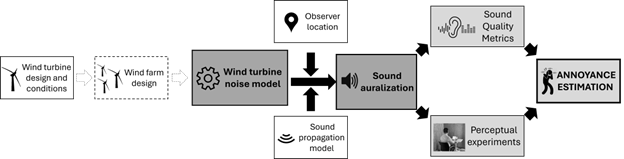
Figure 2– Schematic of the proposed perception-influenced design framework for wind turbines and wind farms.
These developments point towards a paradigm shift: perception-influenced design, see Fig. 2. Instead of simply minimizing an A-weighted level, blade designers and noise-control engineers can target the specific sound features that drive annoyance, i.e. identifying what to tackle “smartly” in perceptual terms. Psychoacoustic evaluation in the design loop enables ranking competing low-noise technologies not by decibels saved, but by annoyance and perceptual improvements. Auralization is a powerful enabler of this vision [3]. By synthesizing physically accurate, audible renditions of future wind farms, ideally reproduced in immersive listening facilities, developers and authorities can let local communities hear proposed scenarios before a single turbine is erected, instead of discussing decibel values, which are often confusing for the general public. This fosters transparency and trust in the planning process, as these tools provide actionable information for the optimal placement and operation of turbines around populated areas [6]. For example, a few large turbines might be energetically more efficient but emit more noise at predominantly lower frequencies, which is more challenging to mitigate (Fig. 3). On the other hand, several smaller turbines may require more land but produce lower noise emissions and mostly at higher frequencies, which attenuate more easily with distance. Which configuration is preferable from the residents’ point of view? Perception-based comparisons of exactly such trade-offs, using auralization, psychoacoustic analyses, and listening experiments, can help elucidate this dilemma [7].
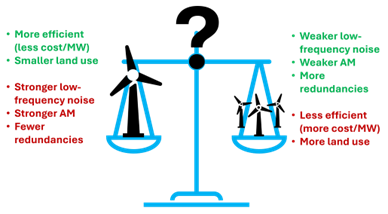
Figure 3- Conceptual comparison of two wind farm layouts with equal energy production: a few large turbines (left) vs. many smaller turbines (right).
Conclusions
Wind energy will keep expanding, and turbines will keep growing. Ensuring public acceptance requires placing human perception at the heart of the entire chain, from blade design, through noise assessment metrics, to wind farm planning and community engagement. The tools are maturing quickly. The main challenge for our community is to bring them into standards, regulations, and everyday engineering practice.
Bibliography
[1] L. Fredianelli, S. Carpita, and G. Licitra, “A procedure for deriving wind turbine noise limits by taking into account annoyance,” Science of the Total Environment, 648, 728–736, 2019. DOI: 10.1016/j.scitotenv.2018.08.107.
[2] van den Berg, F., “The relevance of AM mitigation,” 10th Convention of the European Acoustics Association (Forum Acusticum), 11-15 September 2023, Torino, Italy. DOI: 10.61782/fa.2023.0069.
[3] Merino-Martinez, R., Pieren, R., and Schäffer, B., “Holistic approach to wind turbine noise: From blade trailing-edge modifications to annoyance estimation,” Renewable and Sustainable Energy Reviews, Vol. 148, No. 11285, pp. 1-14, 2021. DOI: 10.1016/j.rser.2021.111285.
[4] Greco, G.F., Merino-Martinez, R., Osses, A., and Langer, S.C., “SQAT: a MATLAB-based toolbox for quantitative sound quality analysis,” 52nd International Congress and Exposition on Noise Control Engineering, 20-23 August 2023, Chiba, Greater Tokyo, Japan. DOI: 10.3397/IN_2023_1075.
[5] Merino-Martinez, R., Pieren, R., Schäffer, B., and Simons, D.G., “Psychoacoustic model for predicting wind turbine noise annoyance,” 24th International Congress on Acoustics, 24-28 October 2022, Gyeongju, South Korea.
[6] Manohare, M., Garcia Guerrero, S., O’Hora, D., and King, E., “Noise annoyance mapping for wind turbines: a psychoacoustic approach incorporating noise sensitivity,” Applied Acoustics, Vol. 248, No. 111280, 2026. DOI: 10.1016/j.apacoust.2026.111280.
[7] Pockelé, J.S., and Merino-Martinez, R., “Perceived Noise Impact of Transitioning Towards Larger Wind Turbines Using Auralisations,” 11th International Conference on Wind Turbine Noise, 10-13 June 2025, Copenhagen, Denmark.
About the Author
Dr. Roberto Merino-Martinez is an assistant professor in the Operations & Environment (O&E) section of the Aerospace Engineering Faculty at Delft University of Technology (TU Delft, the Netherlands). He is also the director of the Psychoacoustic Listening Laboratory (PALILA). He obtained his PhD cum laude in the field of aircraft noise and aeroacoustics in 2018. His research interests include phased microphone arrays, acoustic imaging, psychoacoustics, and noise reduction techniques for aircraft, drones, and wind turbines.