What goes around comes around: Acoustical research on the NASA turbines in today’s infrasound debate
By Isaac Old, Senior Acoustician, Stantec
1. Introduction
In the mid 1970s through the early 1990s NASA researchers conducted acoustical research on a series of prototype wind turbines, publishing the results in a series of research studies and technical papers. When complaints about wind turbine sound became more common with the rapid buildout of wind turbines across the world in the mid 2000s, a number of researchers, authors, and citizens searched for answers in this literature. This article will look into the content of these studies, calibrating their relevance to the current wind turbine acoustics debate.
2. NASA Large Turbine Program Sound Research
By any measure the NASA large wind turbine studies were a tremendous accomplishment and they still rank among the most noteworthy and comprehensive wind turbine acoustics studies that have been performed by any institution. Though the beginning and end of these studies is not well defined, we will look into papers released between about 1980 and 1990. These studies summarize research on a series of prototype horizontal axis wind turbines (HAWT) that include the MOD-0A, MOD-1, MOD-2, and WTS-4. These turbines were produced by a number of manufacturers including Boeing, General Electric, Westinghouse, and United Technologies. A comparison of these turbines is shown in Figure 1. Note that this was published before the MOD-5B was constructed, so actual details changed [1]. The MOD-5A was never constructed. As these turbines were intended to be experimental there is some design variability. Output ranged from the 200 kW MOD-0A to the 4000 kW WTS-4.[1] Three of the turbines were a design where the rotor spins downwind of the tower (a “downwind” turbine) and three were where the rotor spins upwind of the tower (an “upwind” turbine). Two of the turbines (the MOD-0A and MOD-1) used latticed towers and the remainder used monopole designs. Each of the turbines had two blade rotors instead of the current standard three blades.
Detailed acoustical studies of the turbines started after a string of noise complaints near installation of a MOD-1 turbine in western North Carolina. The complaints were from roughly a dozen residences that were located within 3 km of the turbine and centered around low frequency (sound with a frequency between about 20 and 200 Hz) thumping sound and some reports of vibration. From there, studies focused on diagnosing the issue using a combination of sound and vibration measurements, both near the turbines and at the residences, along with meteorological measurements. Field measurements, wind-tunnel studies, and analytical investigations demonstrated that rotor blades passing through the organized wakes of the cylindrical tower legs experienced transient aerodynamic loading fluctuations that produced coherent low-frequency sound impulses. The tower was creating substantial wind speed gradients that meant the blades were encountering dramatically different wind conditions behind the tower compared to the rest of the swept rotor area. The rapid change in effective wind speed vibrated the rotor, generating the thumping sound. This effect was further exacerbated by the use of the latticed tower instead of a monopole tower, and the relatively close spacing between the rotor plane and the tower [2]. The latticed tower resulted in three wakes instead of the one that would occur with a monopole tower and the close spacing between the rotor plane and tower resulted in a more dramatic wind speed gradient.
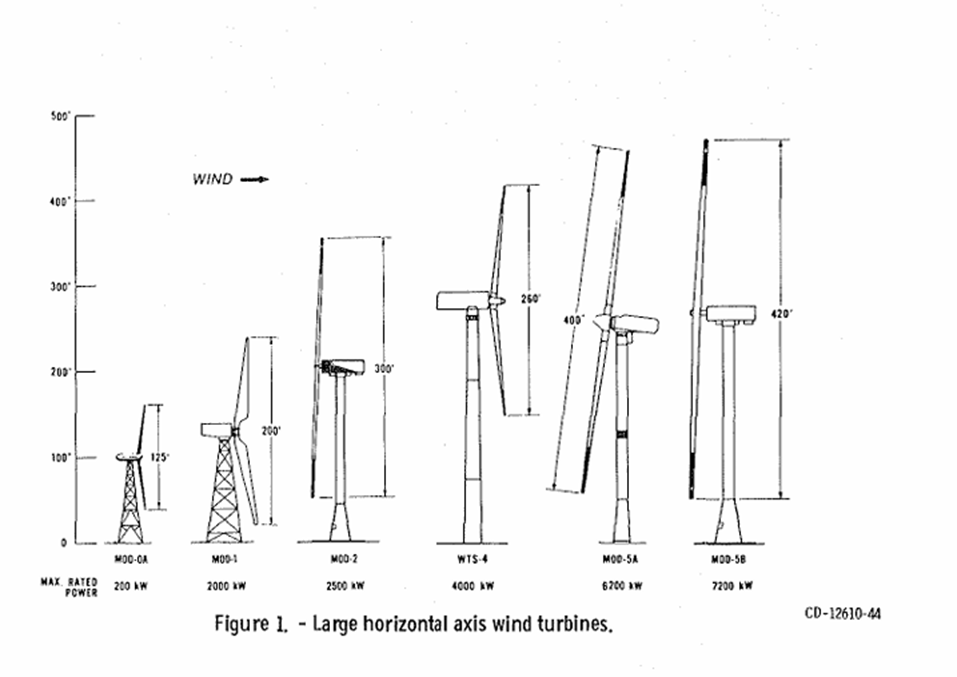
Figure 1: Comparison of turbines in the NASA Large Wind Turbine program [1]
Annoyance was due to the low frequency sound pulses making residential structures vibrate. Some of the sound was mitigated by slowing the rotor rotation (originally 35 rpm) and adding aerodynamic devices to the legs to break up the wind speed gradients. Additional testing was done later with the more adjustable MOD-0A turbine that included flipping the rotor upwind of the tower. Operation in the upwind configuration eliminated the impulsive low frequency sound that drove complaints. Later tests of the upwind configuration MOD-2 turbine also did not find impulsive sound similar to the MOD-1 [3], [4].
A couple of years later a lab test was performed to develop a wind turbine annoyance assessment metric. The tests simulated wind turbine sound inside a residence under three different scenarios, two of which included impulsive low frequency sound [5]. The idea was to assess which metric provided the best correlation between sound levels and participant response. Two metrics provided the best correlation. The first was the C-weighting metric and the second was the LSL (Low frequency Sound Level) weighting metric. The C-weight metric emphasizes low- to mid-frequency sound, by de-weighting infrasound (sound with a frequency below 20 Hz) and high frequency sound. The LSL emphasizes low frequency sound while de-emphasizing infrasound and mid-frequency sound. The correlation coefficients of participant response for both of these metrics was similar. Unweighted sound levels, two proposed G-weighted metrics and A-weighted did not correlate as well with response as C-weighting and LSL. The G-weighted metrics were slightly different. The basic concept was the same, with audible-frequency sounds being de-weighted and the weighting following the audibility threshold curve in the infrasonic range. The basic differences are steeper de-weighting rates in the infrasonic range and a frequency shift of where it started de-weighting. The suggested annoyance threshold for wind turbine sound was 67 dBC for impulsive sounds and 75 dBC for non-impulsive sounds. The importance here is that both of the best performing metrics emphasize low frequency sound over infrasound. Due to common building façade attenuation characteristics, higher frequency sound will generally be attenuated more than mid- or low-frequency sound during transmission through the structure.
Additional NASA research focused on characterizing the acoustic emissions of the experimental turbine fleet and the propagation of wind turbine sound. Measurements of the WTS-4 showed that blade-passage-frequency harmonics could propagate long distances downwind, with attenuation rates influenced strongly by atmospheric refraction rather than simple spherical spreading [6], [7].
Overall, the NASA studies found that low-frequency noise generation, propagation, and structural response depend on turbine configuration, wake aerodynamics, atmospheric conditions, and the dynamic response of nearby buildings. Downwind turbines, particularly the MOD-1, produced the strongest coherent low-frequency and impulsive emissions due to blade interactions with tower wakes, while upwind designs substantially reduced these effects [8].
Several findings remain relevant today. The studies showed that wind turbine sound radiation is directional at close range, that low- and mid-frequency emissions arise from a combination of mechanical and aerodynamic noise sources, and that low-frequency and infrasonic spectra commonly contain harmonics generated by periodic rotor loading at the blade-passage frequency.
3. Current Positioning in the Wind Turbine Infrasound Discussion
In the past 15 years, the NASA wind turbine noise studies have repeatedly reappeared in the wind turbine acoustics literature and in regulatory, legal, and public discussions of wind turbine noise. Much of the attention has focused on the studies of the 2 MW MOD-1 wind turbine that were initiated in response to community noise complaints. As concerns about infrasound from modern utility-scale wind turbines grew, these studies were cited as evidence that complaints associated with turbine-generated low-frequency sound were not a new phenomenon and that large wind turbines had long been recognized as sources of significant infrasonic and low-frequency sound energy. The finding that low frequency sound could interact with residential structures has also been referenced. This in combination with increased audibility due to the impulsive coherent characteristic of the sound was used to explain how relatively low infrasound levels could result in human responses [9] [10].
4. Comparison of Study Findings and the Current Debate
These discussions often overlook important distinctions between the early experimental turbines and modern commercial designs. The MOD-1 was a downwind turbine whose impulsive acoustic emissions were strongly influenced by blade-tower interaction, whereas nearly all modern utility-scale turbines employ upwind rotor configurations. In Hubbard and Shepherd they state “Impulsive noise is often associated with downwind rotors on HAWTs” [8]. Comparisons of the acoustic time series and spectra for the two turbine types show that the upwind turbine time series does show a modulated amplitude, but without the sharp impulses of the downwind turbine. Overall sound levels from the upwind design in the low frequency sound range are also approximately 10 dB lower even for a physically larger turbine. Findings related to the MOD-1 that are generalized to contemporary turbines are done without consideration to what made its sound emissions unique. Some reviews of the NASA studies do acknowledge that the MOD-1 is different from current turbines, but then assert that the differences are irrelevant. The NASA researchers did not come to that conclusion.
Portions of the NASA lab studies on wind turbine annoyance metrics do not allow for simple application to infrasound. They indicate that sound in the low frequency range, particularly when impulsive, was the primary response driver. The metrics that best correlated with response are those that de-emphasize infrasound relative to low frequency sound. The NASA study also does not implicate infrasound as the issue, instead focusing on low frequency sound.
This difference is sometimes avoided in articles alleging infrasound as a driver of response through use of the phrase Infrasound and Low Frequency Noise (ILFN). Although infrasound is often reported as being the more harmful and unique portion or the sound spectrum, combining the two means previous research on low frequency sound tends to be applied to infrasound. In most cases this is an inappropriate application, particularly if the infrasound levels being referenced are below the audible range.
In the case of the NASA studies, the annoyance threshold was specified as being 67 dBC for impulsive sound and 75 dBC for non-impulsive sound. Wind turbine sound at these levels was audible. When findings of these studies are erroneously applied to inaudible infrasound, the disconnect should be apparent.
5. Conclusion
Acoustical studies that were part of NASA’s Large Wind Turbine program formed some of the earliest acoustical research on wind turbines, even today ranking as one of the most in-depth research projects on the subject. Topics ranged from wind turbine sound emission mechanisms, to sound measurement techniques, human response, and sound propagation. Recent discussions on wind turbine infrasound have focused on these studies due to a series of complaints near the installation of a MOD-1 prototype turbine in western North Carolina that were attributed to a strong low frequency thump emitted by the turbine This is often taken as evidence that high levels of infrasound are an intrinsic sound emissions of wind turbines and hit characteristic has been known for decades. A close review of the NASA studies indicates the following:
- High low frequency sound levels, particularly when impulsive, were primarily a characteristic of now obsolete downwind turbine designs. Upwind turbine designs were not the subject of complaints, had lower low frequency and infrasound levels, and showed much less impulsivity.
- Low frequency sound was the primary driver of annoyance rather than sub-audible infrasound.
To understand the impact of infrasound from modern wind turbines, it is important to understand the findings of past and current research, and communicate it accurately to those affected.
Acknowledgements
Special thanks to Jacob Poling and Scott Hamilton for providing helpful suggestions.
About the Author
Isaac Old is a Senior Acoustician at Stantec based in New Hampshire. He specializes in acoustical consulting for power generation and transmission, mining and aggregate, and data centers among others. He has been acoustical consulting approximately 16 years and has written on the topics of community noise, dose response, wind turbine operational control acoustics, and sound transmission loss.
6. Bibliography
[1] R. Thomas, “DOE/NASA Lewis large wind turbine program,” National Aeronautics and Space Administration, Cleveland, Ohio, 1982.
[2] N. Kelley, H. McKenna, R. Hemphill, C. Etter, R. Garretts and N. Linn, “Acoustic noise associated with the MOD-1 wind turbine: Its source, impact, and control,” Solar Energy Research Institute, Golden, Colorado, 1985.
[3] C. Etter, N. Kelley, H. McKenna, C. Linn and R. Garretts, “Acoustical measurements of DOE/NASA MOD-0 wind turbine at Plum Brook Station, Ohio,” Solar Energy Research Institute, Golden, Colorado, 1983.
[4] N. Kelley, H. McKenna, E. Jacobs, R. Hemphill and N. Birkenheuer, “The MOD-2 wind turbine: Aeroacoustical noise sources, emissions, and potential impact,” Solar Energy Research Institute, Golden, Colorado, 1988.
[5] N. Kelley, “A proposed metric for assessing the potential of community annoyance from wind turbine low-frequency noise emissions,” in Windpower ’87, San Francisco, 1987.
[6] K. Shepherd and H. Hubbard, “Measurements and observations of noise from a 4.2 megawatt (WTS-4) wind turbine generator,” NASA Contractor Report 166124, Hampton, Virginia, 1983.
[7] W. Willshire, “Long range downwind propagation of low-frequency sound,” NASA Technical Memorandum 86409, Hampton, Virginia, 1985.
[8] H. Hubbard and K. Shepherd, “Wind turbine acoustics,” NASA Technical Paper 3057, 1990.
[9] R. James, “Wind turbine infra and low-frequency sound: Warning signs that were not heard,” Bulletin of Science, Technology & Society, vol. 32, no. 2, pp. 108-127, 2012.
[10] J. Punch and R. James, “Wind turbine noise and human health: A four-decade history of evidence that wind turbines pose risks,” Hearing Health and Technology Matters, 2016.
[11] Y. Tokita and S. Nakamura, “Frequency weighting characteristics for evaluation of low frequency sound,” in Internoise 81, 1981.
[12] N. Kelley, R. Hemphill and M. H., “A comparison of acoustic emission characteristics of three large wind turbine designs,” in InterNoise 82, San Francisco, 1982.
[13] N. Kelley, R. Hemphill and H. McKenna, “A methodology for assessment of wind turbine noise generation,” Journal of Solar Energy Engineering, vol. 104, pp. 112-120, May 1982.
[14] N. Kelley, “Acoustic noise generation by the DOE/NASA MOD-1 wind turbine,” Wind Energy Branch – Solar Energy Research Institute, Golden, CO.
[1] Sources differ on what the actual output of the MOD-5B was.