Temperature Inversions and Wind Turbine Noise: What Long-Term Field Data Shows
By Brooklynn Bennitt, Duncan Halstead, Aercoustics Engineering Limited
Temperature inversions have long been considered one of the atmospheric conditions that can drastically increase sound levels at nearby receptors. The theory is straightforward: when the air temperature gradient is positive (temperature increases with height), sound refracts downward toward the ground, potentially increasing noise levels experienced by residents.
However, a long-term monitoring study conducted by Aercoustics Engineering Limited suggests the relationship may be more complex than conventional wisdom implies. Drawing on detailed acoustic measurements, turbine operational data, and meteorological tower data, the study found only a weak relationship between inversion strength and measured wind turbine noise levels. While stronger inversions were associated with higher sound levels, the effect was inconsistent and often overshadowed by other environmental and operational factors. These findings provide valuable real-world evidence for a topic that has historically been discussed largely through theory and modelling.
A Question Worth Testing
Temperature inversions are a familiar concept to atmospheric scientists and acousticians alike. Under typical conditions, temperature decreases with height, causing sound waves to refract upward. During an inversion, the opposite occurs: warmer air sits above cooler air, increasing sound speed with height and refracting acoustic energy downward.
Atmospheric stability effects are already incorporated, either directly or indirectly, into many commonly used environmental noise and dispersion modelling approaches, including ISO 9613-2, Nord2000, and Concawe/Harmonoise. For wind turbines, however, the situation is especially interesting because the source of the sound is elevated well above grade and turbine noise emissions are themselves closely tied to atmospheric conditions.
Despite widespread assumptions about inversion effects, relatively little long-term field data exists that directly compares inversion strength with measured wind turbine sound levels. An opportunity to examine a large monitoring dataset prompted the Aercoustics team to investigate whether inversion strength could be clearly linked to higher sound levels in practice.
Measuring More Than Just Noise
The study was conducted at a rural wind farm characterized by relatively flat terrain. Analysis combined measurements from noise monitoring equipment, local weather measurements, turbine SCADA data, and a meteorological tower extending to near hub height. The acoustic monitoring campaign was supplemented by approximately 1.5 years of meteorological tower data, providing a broader understanding of atmospheric behaviour across the site.
To ensure the analysis focused on turbine-related sound, we carefully screened and filtered the dataset. We compared the resulting measurements against predictions from ISO 9613-2 modelling, allowing us to assess whether measured levels differed systematically under stronger inversion conditions.
Binned Results: A Weak Overall Correlation
To look more closely at the trend, sound levels were grouped into bins based on inversion strength.
As shown in Figure 1, average sound levels generally increased as inversion strength increased. At first glance, this appears to support conventional expectations regarding atmospheric refraction. However, a closer examination revealed that the differences between inversion categories were relatively small and that variability within each category was substantial. Error bars representing the standard deviation often overlapped significantly between neighbouring bins.
The overall relationship between inversion strength and sound level was positive but weak. In practical terms, the results suggest that stronger inversions may contribute to elevated sound levels on average, but inversion strength by itself is not a reliable single predictor of what will be measured at a receptor location.
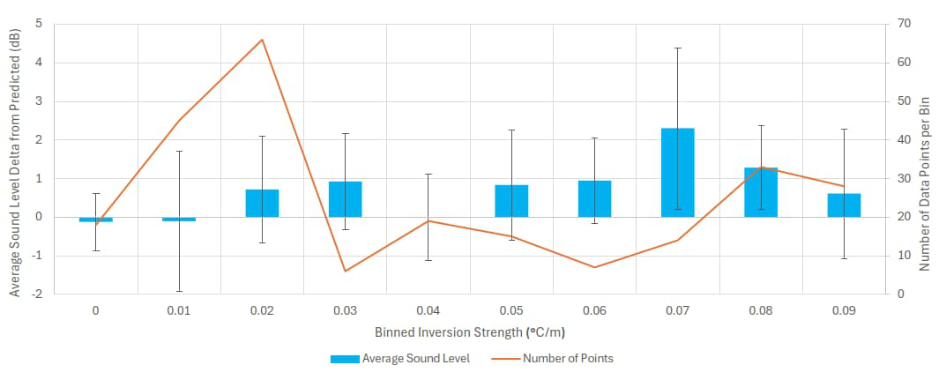
Figure 1: Average Different Between Measured and Predicted Sound Levels in the Downwind Condition, Binned by Inversion Strength.
Case Studies: Inconsistent Night-to-Night Behaviour
The limitations of relying solely on inversion strength became even clearer when individual nights were examined, displayed in Figure 2.
In one case study, as inversion conditions developed during the night, sound levels showed a weak upward trend with inversion strength, rising up to 4 dB above predicted levels at the strongest points in the period, though the inversions involved were modest enough that this magnitude of effect wasn’t expected to be significant.
A second case study produced a different pattern. An increasing inversion strength resulted in lower measured sound levels, the opposite of the expected trend. This trend was present despite high observed inversions throughout the night.
Together, the two examples highlight a key takeaway from the study: atmospheric conditions do not operate in isolation. Wind speed, turbulence intensity, humidity, wind shear, and other meteorological variables can all influence measured sound levels, making it difficult to attribute changes to inversion strength alone.
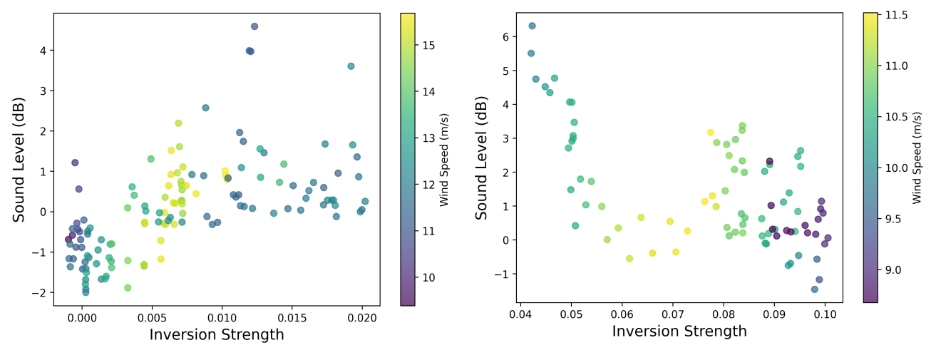
Figure 2: Sound Level Against Inversion Strength Coloured by Hub Height Wind Speed for Two Representative Nights
Long-Term Meteorological Trends
The broader meteorological dataset helped to explain why inversion effects were difficult to isolate.
Analysis of approximately 1.5 years of MET tower measurements showed that strong temperature inversions occurred most frequently during lower wind speed conditions. Conversely, the higher hub-height wind speeds associated with maximum turbine sound emissions were much less likely to coincide with strong inversion events. In fact, strong inversions were relatively uncommon when hub-height wind speeds reached 10 m/s or higher.
This finding is important because it suggests that the atmospheric conditions most favourable to downward refraction do not necessarily occur at the same time as the operating conditions that produce the highest noise emissions of a wind turbine. As a result, the theoretical “worst-case” combination may occur less frequently in practice than is often assumed.
Implications for Practice
The study confirms the underlying physics of sound propagation under temperature inversions, while showing that real-world turbine noise behaviour is shaped by a broader range of variables than inversion strength alone.
While stronger inversions were associated with slightly higher average sound levels, the relationship was weak and highly variable. The two case studies and the longer-term meteorological analysis both suggest that atmospheric stability should be evaluated alongside other factors such as turbulence intensity, humidity, wind shear, and turbine operating conditions. Future studies may benefit from combining these variables to better quantify the complex interactions that govern environmental noise propagation.
Long-term field measurements remain essential for validating assumptions derived from theory and modelling. As increasingly sophisticated datasets become available, they may challenge long-held expectations and lead to a more nuanced understanding of how atmospheric conditions influence wind turbine noise.
About the Authors
Brooklynn Bennitt is a co op student at Aercoustics Engineering Ltd, where she has contributed to projects related to wind turbine noise modelling and analysis, environmental noise modelling, architectural acoustics, and instrumentation testing. She is currently a fourth-year mechanical engineering student minoring in sustainable energy at the University of Toronto.
Duncan Halstead is Vice President of Operations at Aercoustics Engineering Ltd, where he leads technical and operational delivery across a range of environmental acoustics projects. His professional work focuses extensively on the assessment and management of wind turbine noise, supporting renewable energy developments through detailed noise modeling, compliance assessments, and expert interpretation of regulatory requirements.