Eavesdropping on the Endangered Hawaiian Monk Seal
By Kirby Parnell, Marine Mammal Research Program, University of Hawai’i at Mānoa
Beneath the surf of the tropical Hawaiian archipelago, the soundscape reflects the biodiversity of this remote coral reef ecosystem. Snapping shrimp crackle constantly, fish grunt, pop, and drum to defend territory, court mates, and warn off predators, and spinner dolphins whistle and click in protected bays. Among this cacophony, one can also hear low-frequency growling, whining, and the occasional whoop. These unique sounds are part of the endangered Hawaiian monk seal’s (Fig. 1) underwater vocal repertoire, and until 2018, they had only been described once, anecdotally, in the scientific literature.
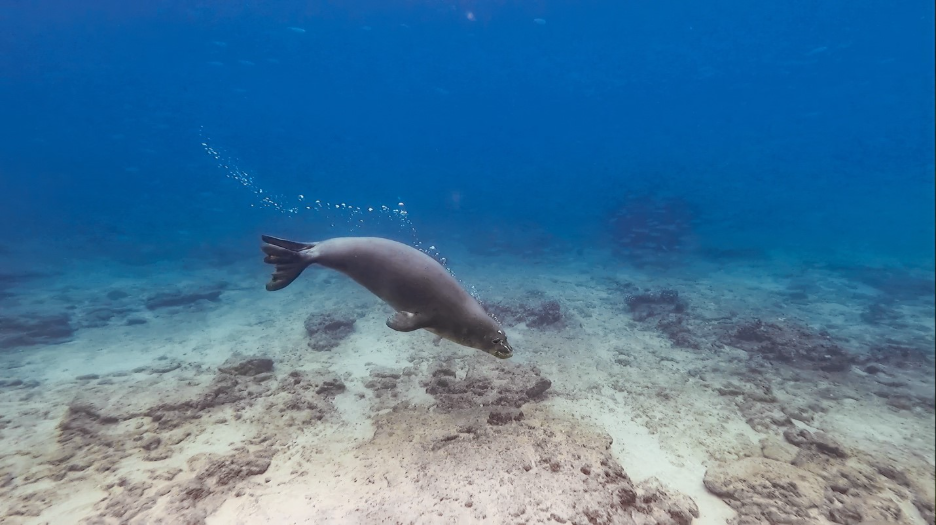
Figure 1. An adult Hawaiian monk seal releasing bubbles through its nose as it vocalizes while swimming. Photo courtesy of Krista Jaspers.
For decades, scientists have recorded underwater sound throughout the Hawaiian Islands, drawn in large part by the song of the humpback whale, which visits Hawaiʻi each winter to breed. Researchers have also used passive acoustics to study other marine mammals, including the insular false killer whale population which numbers fewer than 150 individuals, and spinner dolphins, which are disturbed by human activity roughly 80% of their resting period in shallow bays (Tyne et al. 2018). With this much underwater acoustic data collected in monk seal habitat, one might expect their vocalizations to be well described by now. For various reasons, this is not the case.
Establishing a vocal repertoire
The first recordings and descriptions of Hawaiian monk seal vocalizations came from one adult male, Kekoa (KE18), living in human care. Kekoa was born at Kure Atoll, in the Papahānaumokuākea National Marine Sanctuary (PNMS), and was placed into human care by the U.S. National Oceanic and Atmospheric Administration (NOAA) – which oversees the species’ conservation – after he injured other seals in the wild population.
In 2017, researchers at the University of California Santa Cruz placed a small passive acoustic recorder (a SoundTrap) into Kekoa’s pool. With no other seals present, Kekoa regularly produced six distinctive low-frequency call types: croak, groan, growl, moan, rumble, and whoop, all named onomatopoeically (i.e., a word that copies or makes the sound of what it means). He produced these vocalizations in stereotyped “bouts”, or clusters of calls produced close together in time (Fig. 2). These call types were confirmed in a second captive male, Hoʻailona (KP2), who produced the identical repertoire, again with no other seals nearby. Published in Sills et al. (2021), these findings provided the first description of the species’ underwater vocal repertoire, along with its second underwater audiogram (i.e., hearing abilities). This audiogram revealed that monk seal hearing extends into the same low-frequency range as their calls and as common sources of manmade sounds (e.g., vessel noise).
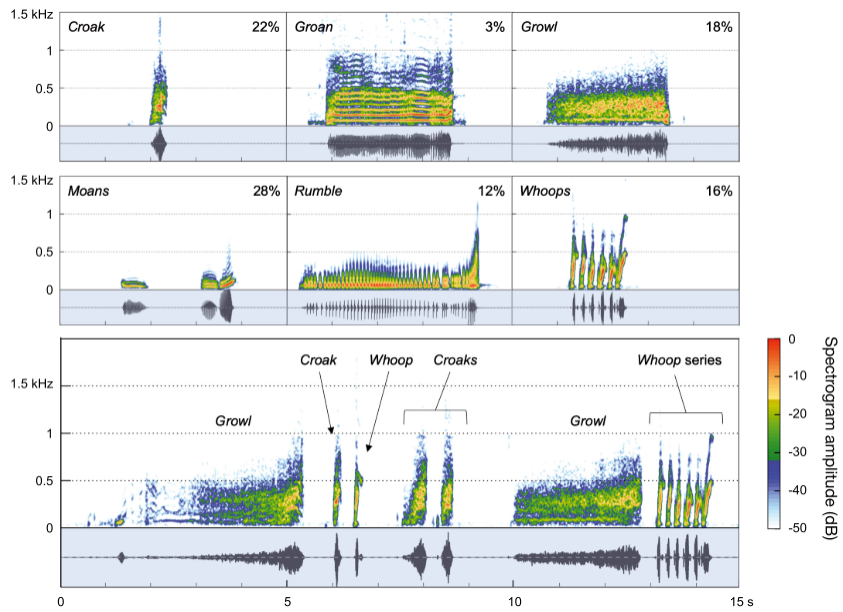
Figure 2. Spectrogram exemplars of Kekoa’s underwater vocal repertoire and a representative vocal bout (from Sills et al. 2021). Listen to Kekoa and Hoʻailona’s vocalizations in the supplemental material: Audio S1 and S2.
These results mattered for two reasons: Hawaiian monk seals are endangered, with roughly 1,600 individuals remaining, and anthropogenic noise is a well-documented stressor for marine mammals. So the fact that monk seals vocalize and hear in the same frequencies as manmade sound raised a critical question: if seals depend on underwater vocalizations for essential behaviors, could noise pollution interfere with them enough to affect survival and reproduction? Before that question could be answered, however, researchers first needed to characterize baseline vocal behavior of wild seals. This meant establishing their repertoire and call characteristics, describing temporal and spatial patterns in sound production, and determining the function of vocalizations.
Confirming calls in the wild
To address these knowledge gaps, Parnell et al. (2025) deployed SoundTraps at five shallow-water sites where Hawaiian monk seals are known to rest and give birth: three in the main Hawaiian Islands (Kalaupapa, Molokai; Manana Island, Oahu; Lehua Rock, Ni’ihau), home to roughly 400 seals living alongside 1.4 million people, and two sites (Lalo and Manawai) inside the PNMS, where the majority of the population (~1,200 seals) lives and human access is restricted to research and cultural activities.
Across more than 4,500 hours of recordings, researchers manually detected over 23,000 vocalizations. Calls were low frequency (<1 kHz, peak frequencies 80 – 305 Hz), short-medium in duration (<7 sec), and often produced in bouts (listen here). Vocalizations were detected at all five sites, and at three sites with the highest seal density, vocalizations were detected throughout the day, suggesting they play a key role in daily behavior. At Lehua Rock, ecotourism vessel noise overlapped in frequency with seal vocalizations, suggesting acoustic masking may occur (Parnell et al. 2024).
Wild seals produced five of the six previously described call types, but with a twist: they also combine these “elemental” calls into more complex “combinational” calls. For example, a quiet, low-frequency moan was often connected to the louder, harsher growl (MoanGrowl). In total, the repertoire now includes up to 25 call types: 6 elemental and 19 combinational (Fig. 3).
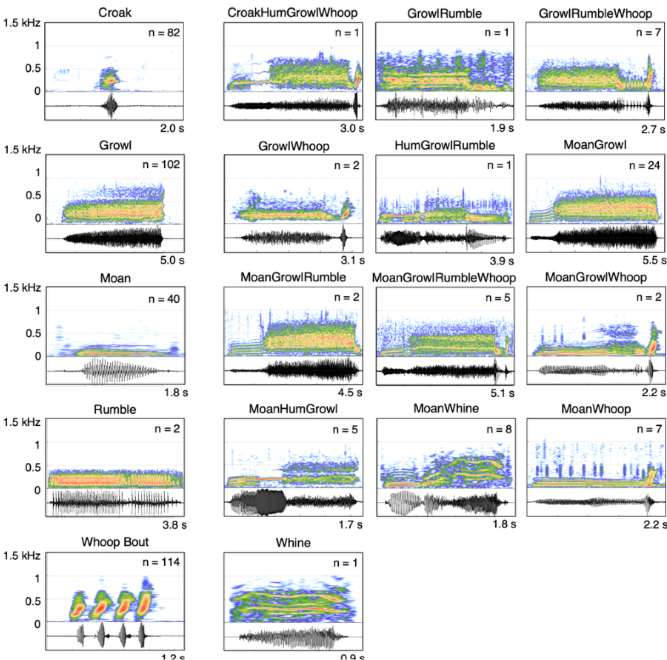
Figure 3. Spectrogram and waveforms of 18 underwater vocal types produced by wild Hawaiian monk seals. Elemental calls are shown in the left column, and all other spectrograms are novel combinational or elemental call types (from Parnell et al. 2025). Listen to these call types here.
What are the calls used for?
One call type tells a clear story. The whine, recorded only in the wild, is produced exclusively while seals forage, body inverted with their head near a coral or reef crevice. This behavior was first documented by recreational snorkelers and divers who posted videos online (watch video examples here). Researchers later confirmed it using paired video-audio data from multi-sensor tags attached to seals’ backs (Chapter 4 in Parnell 2025). It’s still unclear exactly why seals whine while foraging, perhaps to attract or flush prey out of hiding, but this makes the monk seal only the second phocid (true seal) species known to produce a foraging-associated call. The monk seal’s close relative, the northern elephant seal, was observed producing infrasonic sounds in a foraging context (Frouin-Mouy et al. 2024). Notably, adult and subadult female seals whine while foraging too, challenging the assumption that underwater calling is primarily a male behavior.
The whine is the exception, though. The exact function of most calls remains unclear. In other aquatically mating phocids, adult males call during the breeding season to attract mates, defend territory, and assert dominance over rivals. As monk seals mate aquatically, their underwater calls likely serve similar purposes. Kekoa’s testosterone and calling rate both peaked during breeding season and dropped after his annual catastrophic molt, hinting at a reproductive function for calls. However, confirming this in wild seals requires more fine-scale behavioral research – a reminder that we are only beginning to understand the monk seal’s communication system.
Why this matters
Acoustic research on both captive and wild Hawaiian monk seals has shown that underwater vocalizations are integral to their at-sea behavior, used for critical functions including foraging and communication. These low-frequency calls overlap with the frequencies of human-generated noise from shipping, commercial fishing, recreational maritime activities (e.g., ecotourism vessels), coastal construction, offshore windfarm development, and military activities. As Hawaiʻi’s coastal waters grow busier, and the main Hawaiian Island population of seals increases, understanding how seal vocalizations and behavior are impacted by manmade noise is critical for conservation. Considering the multiple threats monk seals already face, from fisheries interactions and disease to shark predation and habitat loss, anthropogenic noise represents another potential stressor layered onto an already vulnerable population. Alongside NOAA’s ongoing population monitoring and recovery efforts, the impacts of anthropogenic noise on this endangered and endemic species should now be a research priority.
About the author

Kirby Parnell is a marine bioacoustician who has studied Hawaiian monk seal underwater acoustic communication for the past decade, throughout her M.Sc. and Ph.D. work. She earned her Ph.D. in Marine Biology from the University of Hawai’i at Mānoa in 2025, following a B.Sc. in Marine Science from Eckerd College and an M.Sc. in Ocean Sciences from the University of California Santa Cruz. She is a co-founder of the nonprofit SMMILE (Summer Marine Mammal Intensive Learning Experiences) and currently serves as a 2026 Grau Fellow with NOAA’s Office of National Marine Sanctuaries, Pacific Islands Region.
Written By: Kirby Parnell, Ph.D.
Affiliation: Marine Mammal Research Program, University of Hawai’i at Mānoa