Recent Advances in Noise Reduction of Wind Turbine blades
By Yang Bing, Beijing Goldwind Science & Creation Windpower Equipment Co., Ltd
Serrated trailing edges (STE) are currently the primary passive noise reduction technology for wind turbine blades. Consequently, most research efforts have focused on optimizing their geometric configurations. However, recent research by Goldwind has shown that vortex generators (VGs) can also reduce blade aeroacoustic noise. Moreover, combining VGs with serrated trailing edges yields superior noise reduction performance.
VGs are mainly used to enhance aerodynamic performance, such as suppressing stall in the root-to-mid span region and mitigating performance degradation caused by surface roughness. Consequently, VGs are typically installed in the root and mid-span sections of the blade. In contrast, serrated trailing edges are predominantly placed the outer one-third span, which is the primary source of aeroacoustic noise. This implies that VGs and STE are generally applied to different spanwise regions on wind turbine blades.
Since 2024, Goldwind has conducted a series of aeroacoustic wind tunnel tests for different airfoils applied in the outer part of blades in the Poul La Cour Wind Tunnel at DTU. These tests have demonstrated that VGs with carefully optimized dimensions and placement can significantly reduce turbulent boundary-layer trailing-edge noise. Furthermore, when these VGs are combined with optimally designed serrations, the noise reduction effect is further enhanced. This combined approach is expected to become a mainstream research direction in aeroacoustics.
Figure 1 illustrates the wind tunnel acoustic test results for one of Goldwind’s airfoils. The measurements were conducted at a constant wind speed of 80 m/s, yielding a Reynolds number of approximately 4×10⁶. The results are presented as sound pressure level versus angle of attack. The clean airfoil, denoted as “Clean,” and the airfoil with zigzag, denoted as “zz,” are each evaluated with various combinations of VG and STE, with the results shown in the left and right panels, respectively. As can be seen from the figure 1, for the clean airfoil, VGs alone achieve a maximum noise reduction of 4.3 dBA at large angles of attack, while serrated trailing edges alone provide a reduction of approximately 3.8 dBA to 4.8 dBA across the tested angle-of-attack range. When combined, the two add-ons yield a maximum noise reduction of 6.4 dBA and a minimum of 4.6 dBA. For the airfoil with zigzag, the noise reduction performance of VGs remains similar to that observed on the clean airfoil.
However, it should be noted that at low angles of attack, the noise reduction effect of VGs is relatively weak and may even be negative for the clean airfoil, as VGs tend to excite blunt-trailing-edge shedding vortex noise. As can be seen from the spectral comparison in Figure 2, while VGs substantially reduce low-frequency noise, they simultaneously introduce high-frequency blunt-trailing-edge shedding vortex noise, which compromises the overall noise reduction. Whether VGs achieve a net noise reduction and to what extent depend on the trade-off between low-frequency attenuation and high-frequency excitation. It can also be observed from Figure 2 that as the angle of attack increases, the frequency of the blunt-trailing-edge shedding vortex noise rises while its sound pressure level decreases, and may eventually disappear which explains the more pronounced noise reduction effect of VGs at large angles of attack.
It should be noted that although VGs may excite blunt-trailing-edge shedding vortex noise at low angles of attack, this does not necessarily increase the overall noise beyond that of the clean airfoil. Whether the overall noise increases depends on the trailing-edge thickness and airfoil geometry. In Goldwind’s tests, some airfoils show no noise increase with VGs. The results presented here are deliberately selected from cases where VGs do increase noise at low angles of attack, to better illustrate the potential impact of VGs, which will be further analyzed in the following discussion.
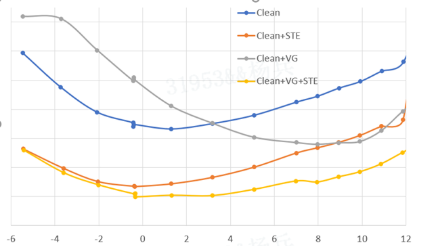
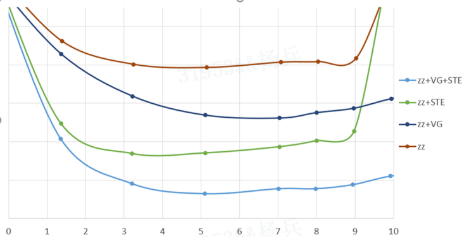
Figure 1: Comparison of wind tunnel noise measurements for the clean airfoil (top) and the zigzag airfoil (bottom) with various VG and STE configurations (vertical scale: 2 dBA per division).
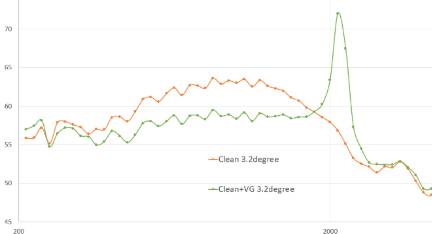
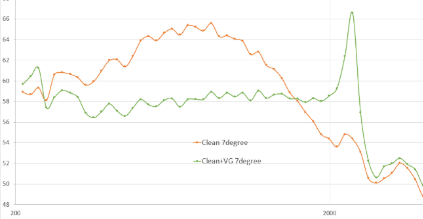
Figure 2: Spectral comparison for the clean airfoil without VGs (“Clean”) and with VGs at angles of attack of 3.2° (top) and 7° (bottom).
A series of noise test results on different airfoils with VGs and serrated trailing edges conducted by Goldwind all show similar trends and noise reduction performance. Based on the measurement results, the noise reduction mechanism of VGs is likely as follows: they inject streamwise vortices into the inner layer of the boundary layer, disrupting the spanwise vortex correlation at the trailing edge while simultaneously reducing the thickness of the spanwise-vortex-dominated boundary layer. This results in a substantial reduction of low-frequency noise, which is a key contribution to the overall attenuation of turbulent boundary-layer trailing-edge noise. However, because the spanwise-vortex-dominated boundary layer is thinned, at angles of attack where the blunt-trailing-edge shedding vortex noise of the clean airfoil is not prominent, the addition of VGs renders blunt shedding vortex noise more noticeable.
Particular attention should be paid to the impacts of VGs on aerodynamic performance and structural loads when applying them to wind turbine blade noise reduction. Unlike serrated trailing edges, which can be designed to have essentially no impact on aerodynamic performance (e.g., lift-to-drag ratio), VGs exert a more pronounced influence in this regard. Nevertheless, judicious design can mitigate this impact. Therefore, a comprehensive trade-off among aerodynamic performance, structural loads, and noise reduction is required when employing VGs. However, as the noise reduction capability of serrated trailing edges alone approaches its limit, the combination of VGs and serrated trailing edges emerges as a promising solution for future wind turbine blade noise control.
Authors Bio:
The author holds a Ph.D. in Aerospace Propulsion Theory and Engineering from Beihang University (BUAA). From 2007 to 2016, she worked at the Institute of Engineering Thermophysics, Chinese Academy of Sciences, focusing on wind turbine blade noise. In 2016, she joined Goldwind. From 2016 to 2022, she managed on-site noise measurements and noise reduction solutions for wind turbines and wind farms. Since 2023, she has been dedicated to blade noise reduction and aerodynamics.