Revising IEC 61400-11: Building Consensus for the Next Generation of Wind Turbine Acoustic Measurements
By: Lars Sommer Søndergaard, Project leader for IEC 61400-11 revision, lss@forcetechnology.com
For more than two decades, IEC 61400-11 has served as the internationally recognized framework for measuring and characterizing wind turbine acoustic emissions. The standard provides a common methodology that enables manufacturers, test laboratories, certification bodies, developers, regulators, consultants, and researchers to evaluate wind turbine noise in a consistent and comparable manner.
The current edition is based on Edition 3, published in 2012, and Amendment 1, published in 2018. Together, these documents continue to form the basis for most wind turbine acoustic emission measurements performed worldwide. As the newly initiated revision begins, it is worth reflecting not only on the technical evolution of the standard, but also on the role it plays in establishing confidence, comparability, and trust across the global wind industry.
A Brief History of IEC 61400-11
The development of IEC 61400-11 has closely followed the growth of the wind industry. As turbines became larger and more widely deployed, the need for internationally harmonized acoustic measurement methods became increasingly apparent.
The 2002 edition established a globally accepted methodology for characterizing wind turbine noise emissions, including procedures for determining sound power levels, assessing tonal characteristics, and relating acoustic emissions to wind speed. A major revision followed in 2012 with Edition 3, introducing enhanced data reduction procedures and updated methodologies. Amendment 1, published in 2018, refined and clarified parts of the standard and remains part of the current consolidated version.
Today, IEC 61400-11 is the global reference for wind turbine acoustic characterization and is widely used for certification, environmental assessments, permitting, and noise prediction studies.
Why IEC 61400-11 Matters
The continued relevance of IEC 61400-11 stems from its ability to provide a consistent and repeatable measurement methodology. By defining requirements for instrumentation, measurement locations, meteorological observations, operational data, and analysis procedures, it ensures that measurements performed anywhere in the world can be compared with confidence.
The standard enables fair comparison between turbine models, supports regulatory decision-making, and provides the acoustic emission data required for environmental noise prediction. In many respects, it forms the common language through which wind turbine acoustic performance is communicated internationally.
The Measurement Principle Behind IEC 61400-11
At its core, IEC 61400-11 is an acoustic emission characterization standard rather than a community noise assessment standard. Its purpose is not to determine the noise level at a specific residence, but to characterize the noise generated by a wind turbine in a consistent and repeatable manner.
The principle is straightforward: measure the turbine close enough to minimize propagation-related uncertainties while remaining far enough away for the turbine to be treated as an acoustic source. Acoustic measurements are combined with meteorological and operational data to characterize turbine noise as a function of wind speed.
In its simplest form, the objective of IEC 61400-11 is:
To determine the acoustic emission characteristics of a wind turbine by measuring sound, meteorological conditions, and turbine operation simultaneously, and expressing the turbine’s noise emission as a function of wind speed in a manner that is repeatable, comparable, and independent of a specific project location.
This principle has remained at the heart of the standard throughout its evolution.
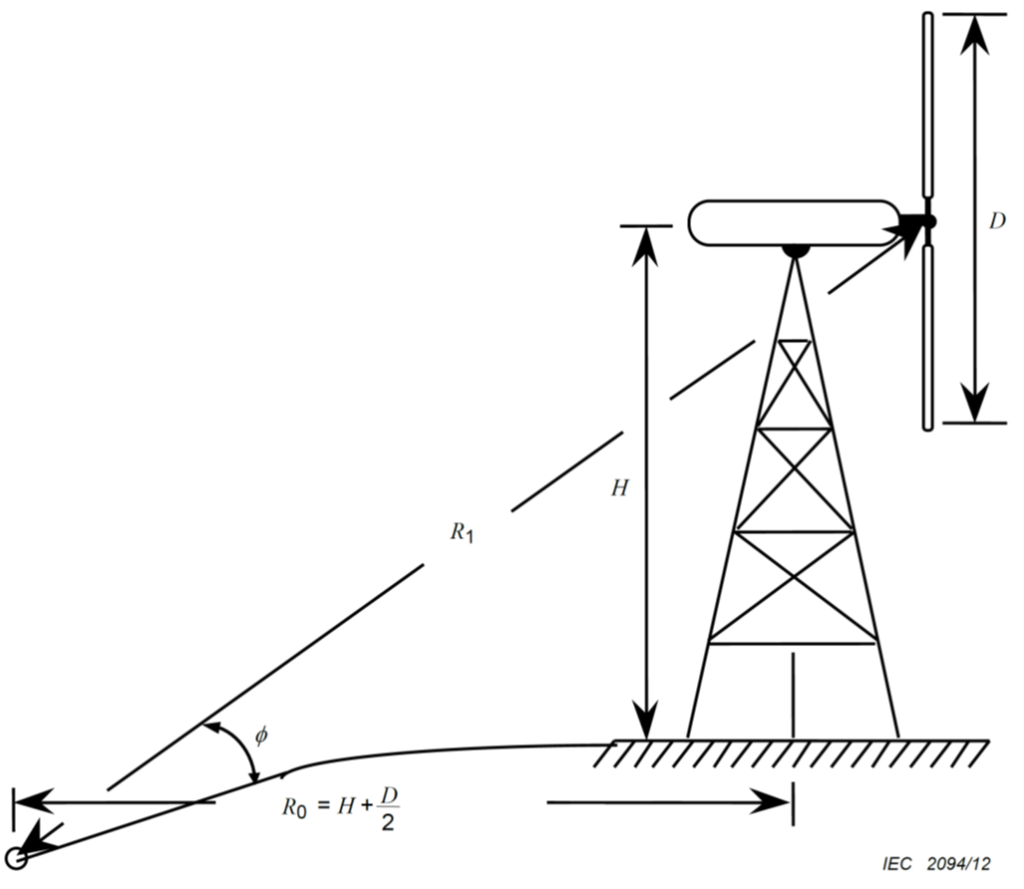
Figure 1: Showing the microphone measurement position for a horizontal axis turbine. The figure is from IEC 61400-11:2012+AMD1:2018 CSV “Copyright © 2026 IEC Geneva, Switzerland. www.iec.ch”
From Simple Principle to Challenging Practice
Although the fundamental principles of IEC 61400-11 are relatively straightforward, anyone who has participated in a measurement campaign knows that their practical implementation is anything but simple.
At first glance, the objective appears clear: measure the turbine noise, measure the wind conditions, correlate the two, and derive a reliable characterization of the turbine’s acoustic emissions. In reality, however, obtaining high-quality data often requires a combination of technical expertise, patience, and a certain degree of cooperation from the weather.
Unlike many other acoustic measurements, wind turbine noise measurements cannot be performed on demand. Wind is required to operate the turbine and generate representative acoustic emissions, but the same wind also creates challenges for the measurement itself.
Wind excites vegetation, buildings, and other environmental features, generating background noise that can influence the measurement. The stronger the wind becomes, the more difficult it can be to distinguish turbine noise from ambient sound sources. At the same time, great care must be taken to prevent wind-induced noise from contaminating the microphone signal. The use of windscreens is therefore essential.
Weather conditions rarely follow the measurement schedule. Forecasts may suggest ideal conditions only for reality to develop differently, while valuable measurement opportunities often arise unexpectedly. Successful campaigns therefore depend not only on instrumentation and methodology, but also on flexibility, persistence, and a measure of good fortune.
This combination of acoustic science, meteorology, and operational turbine behavior is one of the aspects that makes IEC 61400-11 both challenging and fascinating. It also explains why practical experience remains so important in the ongoing revision.

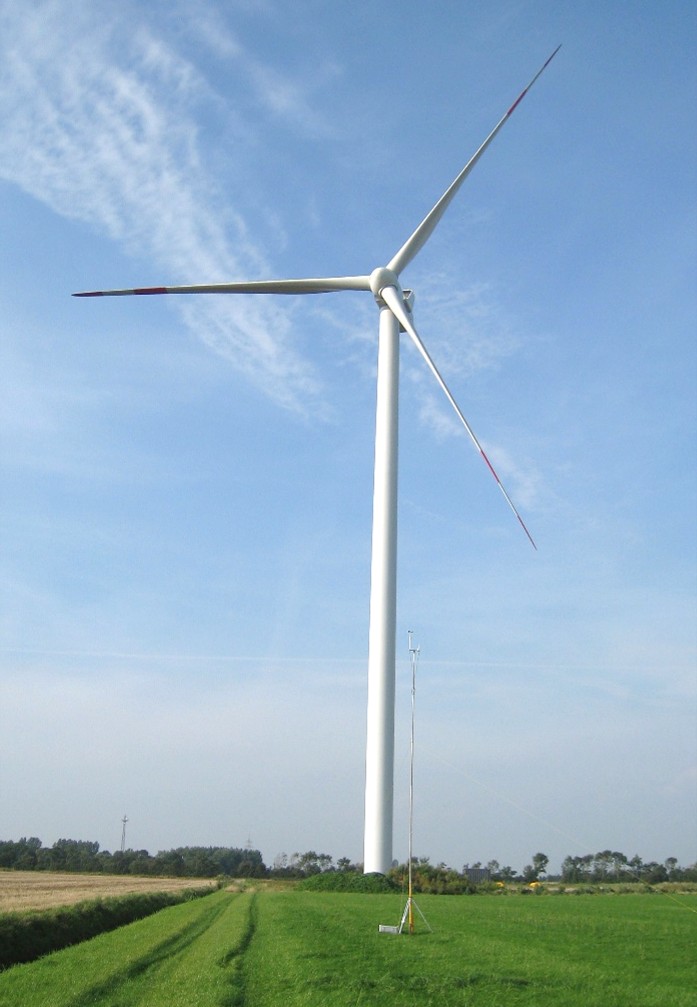
Figure 2: Photos from a measurement. Left: Photo of the microphone under a secondary wind screen on a plate on the ground. Right: Photo of a met mast used to determine wind speed during background noise measurements.
Why Revise a Successful Standard?
If the standard works well, why revise it?
The answer is simple: the wind industry continues to evolve. Modern turbines are significantly larger than those considered when earlier editions were developed, often featuring rotor diameters exceeding 200 m, higher hub heights, advanced operating modes, and increasingly sophisticated noise management strategies.
At the same time, more than a decade of practical experience with Edition 3 has highlighted areas where clarification, simplification, or improvement may be beneficial. The goal of the revision is therefore not change for its own sake, but to ensure that IEC 61400-11 remains technically robust, practical, and internationally relevant.
The revision is being carried out by IEC TC88 Maintenance Team 11 (MT11), which currently consists of 42 experts from around the world representing a broad range of technical backgrounds and stakeholder groups.
Current Topics Under Consideration
The revision is still in its early stages, and a number of technical topics are under discussion. These include:
- Wind speed ranges, measurement methods and devices
- Tonal analysis methodologies
- Background noise handling and correction
- Frequency range requirements
- Atmospheric absorption
- Windscreens
- Uncertainty
- Applicability to small wind turbines
Not all of these discussions will result in changes to the standard. As with any IEC revision, proposals must be evaluated on the basis of technical merit, practical applicability, reproducibility, and international consensus. The revision should therefore be viewed as an open technical discussion rather than a predefined set of changes.
The Importance of Consensus
Perhaps the most important aspect of standards development is consensus.
IEC standards are developed through the participation of experts representing manufacturers, testing organizations, certification bodies, regulators, consultants, researchers, and other stakeholders. Consensus does not mean that everyone gets exactly what they want; it means that different viewpoints are considered, technical concerns are addressed, and the final document achieves broad international support.
For IEC 61400-11, this is particularly important because acoustic measurements underpin certification, project development, environmental assessments, and regulatory approvals. Broad consensus helps ensure confidence in both the methodology and the resulting data.
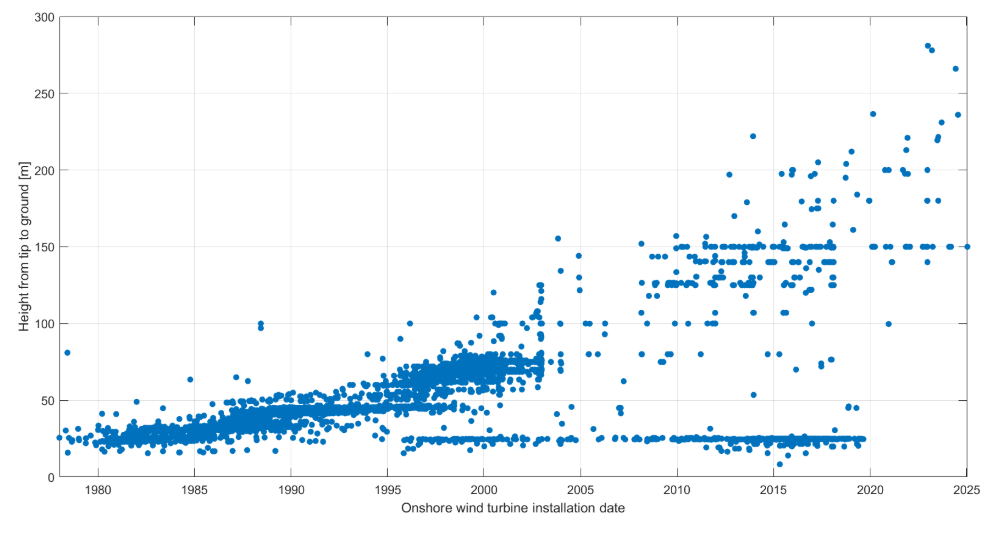
Figure 3: Plot showing the development of the total height (tip-to-ground height) of Danish onshore wind turbines between 1978 and 2025. Data source: the Danish Energy Agency (data merged from two tables).
Invitation to Participate
One objective of this article is to raise awareness of the ongoing revision and encourage wider participation from the acoustics community.
The success of IEC 61400-11 has always depended on contributions from experts with different backgrounds and experiences. As wind turbine technology continues to evolve, broad international participation remains essential to ensure that future editions remain scientifically sound, practically applicable, and globally relevant.
Experts interested in participating should contact their national mirror committee for IEC TC88. Information on IEC National Committees can be found at:
www.iec.ch/national-committees
Participation in IEC technical work takes place through nomination by the relevant National Committee.
Looking Ahead
The revision of IEC 61400-11 marks the beginning of an important and collaborative process. The objective is to build upon a proven foundation while ensuring that the standard remains fit for purpose in an evolving industry.
The success of IEC 61400-11 has always rested on three fundamental pillars: sound science, practical applicability, and international consensus. Those same principles will hopefully guide the current revision and help ensure that IEC 61400-11 remains the trusted global reference for wind turbine acoustic characterization for years to come.
Acknowledgement
The author thanks the International Electrotechnical Commission (IEC) for permission to reproduce Information from its International Standards. All such extracts are copyright of IEC, Geneva, Switzerland. All rights reserved. Further information on the IEC is available from ww.iec.ch. IEC has no responsibility for the placement and context in which the extracts and contents are reproduced by the author, nor is IEC in any way responsible for the other content or accuracy therein.
About the Author
Lars Sommer Søndergaard is a Senior Specialist at Force Technology, a Research and Technology Organisation (RTO) in Denmark. He has nearly 20 years of experience in wind turbine noise and building acoustics. Since 2012, he has been actively involved in international standardization and currently serves as project leader for the revision of IEC 61400-11, the key international standard for measuring wind turbine acoustic noise.