Open Research Data for the Investigation of Sound Propagation from Onshore Wind Turbines
By Susanne Könecke, Tobias Bohne, Raimund Rolfes, Leibniz University Hannover, Institute of Structural Analysis / ForWind, Hannover, Germany, s.koenecke@isd.uni-hannover.de

Experimental studies of sound propagation from onshore wind turbines are essential for understanding atmospheric sound propagation processes and for developing and validating numerical sound propagation models. However, long-term field measurements under real operating and atmospheric conditions are technically challenging and require considerable personnel and financial resources. At the same time, no comprehensive datasets are currently available to the scientific community, restricting reproducible investigations of different research questions.
Against this background, as part of research projects extensive acoustic field measurements were conducted (grant no. 0324134A) and resulting research data were systematically processed (grant no. 03EE3062). Selected datasets were made publicly available at the research data repository of the Leibniz University Hannover in accordance with the FAIR (Findable, Accessible, Interoperable, and Reusable) principles. In addition to a comprehensive one-month measurement dataset, a validated framework for identifying and characterizing wind turbine noise, and datasets for validating numerical sound propagation models, have been published.
This contribution provides an overview of the published datasets and their scientific applications. Further information on the datasets and the underlying scientific research can be found in the corresponding open-access journal articles referenced in the individual sections.
Measurement Dataset for Sound Propagation Studies
Acoustic, meteorological, and wind turbine operational data were synchronously acquired during five measurement campaigns conducted near onshore wind farms in northern Germany. Acoustic measurement stations were installed at three distances from the wind turbine to record acoustic time signals as well as averaged sound pressure levels and third-octave spectra. In addition, meteorological measurements up to a height of 100 m were performed to characterize the atmospheric conditions, and SCADA (Supervisory Control and Data Acquisition) data from the wind turbine were recorded. An overview of the measurement systems is shown in Fig. 1.
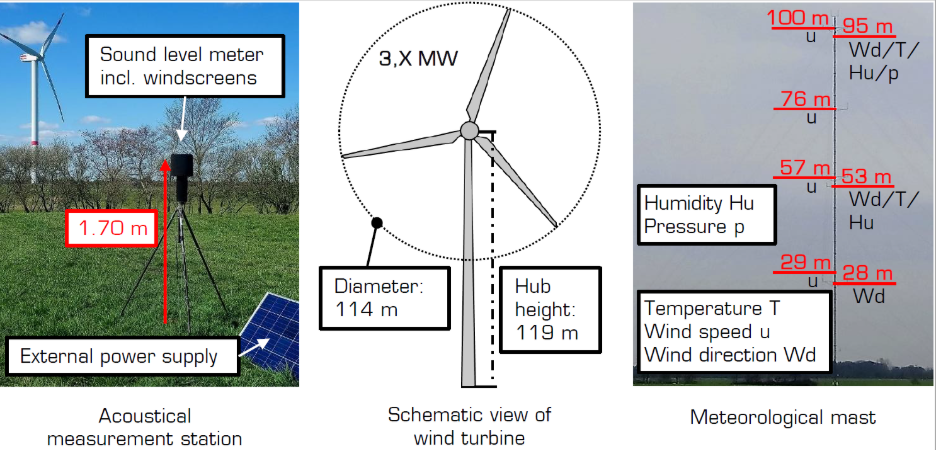
A processed one-month dataset containing all measured parameters was published as open access, enabling a correlation between the measured acoustic signals, the operating state of the wind turbine, and the prevailing atmospheric conditions [1]. The dataset is suitable for investigations of sound propagation under varying atmospheric conditions as well as for addressing questions regarding sound generation and the occurrence of physical phenomena such as amplitude modulation. By making the dataset publicly available, it can be reused in future research.
Identification and Characterization of Wind Turbine Noise
Long-term acoustic measurements contain not only wind turbine noise but also numerous competing noise sources, such as wind-induced noise, vegetation noise, and traffic. The reliable identification of time periods dominated by wind turbine noise is therefore essential for further analyses.
For this purpose, a two-stage framework was developed (see Fig. 2). In the first stage, a preliminary selection is made based on acoustic criteria as well as meteorological and turbine-specific operating data. Subsequently, characteristic modulation frequencies extracted from the acoustic signals are compared with the blade passing frequency of the wind turbine to reliably identify periods dominated by wind turbine noise. Based on these selected periods, characteristic sound components such as amplitude modulation, tonal components, and high-frequency whistling noise can also be automatically determined. The framework was validated using a classified reference dataset derived from a structured listening test. [2]
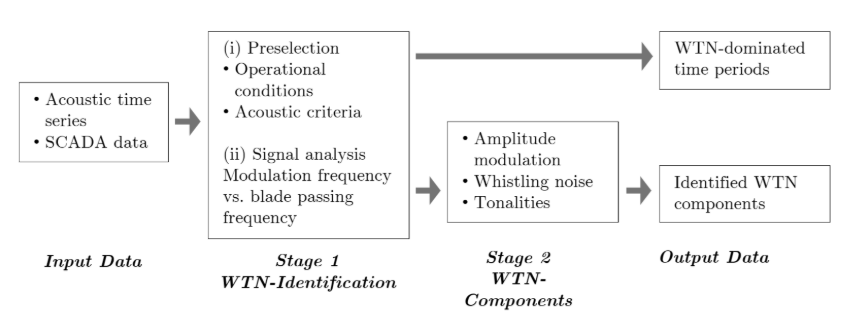
In addition to the scientific publication, the framework, the listening test platform, and example audio files were made publicly available [3]. As a result, a validated method for identifying and characterizing wind turbine noise is now publicly available for the first time.
Reference Dataset for Sound Propagation Model Validation
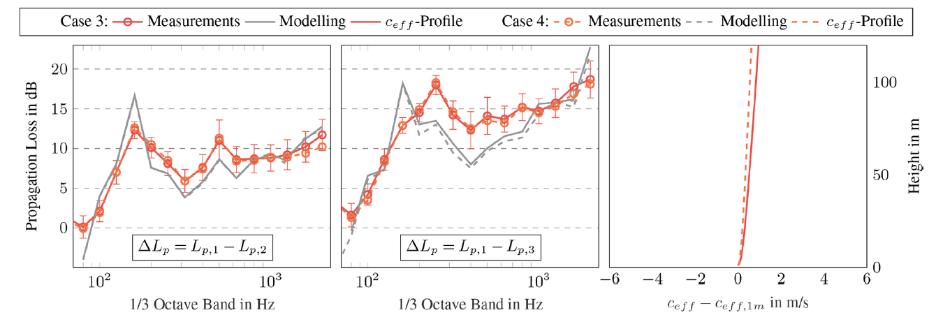
The measurement data were also used to validate a numerical sound propagation model based on the parabolic equation method. The validation comprises ten reference cases representing different atmospheric propagation conditions. The required model input parameters were derived from the measurement data, and the predicted sound propagation losses were systematically compared with the measured results [4]. As an example, Fig. 3 compares measured and modeled sound propagation losses for one-third-octave bands under crosswind conditions. In addition to the measurement data, the published dataset includes all model input parameters and numerical simulation results, thereby enabling reproducible model validation [5].
Conclusions
The published datasets cover different stages of experimental investigations of sound propagation from wind turbines, ranging from measurement data acquisition and standardized data selection to the validation of sound propagation models. Together, they provide the scientific community with a consistent research data basis for a broad range of studies in wind turbine acoustics.
We hope that the published datasets will be adopted by the scientific community, reused in future research, and supplemented with additional reference datasets. This will enable the development of new analysis methods, the reproducible validation of existing models, and the continuous advancement of experimental and numerical methods for investigating sound propagation from wind turbines.
Bibliography
[1] Könecke, S., Schössow, D., Preihs, S., Bohne,T., Grießmann, T., Peissig, J., Rolfes, R. (2023). WEA-Acceptance Data: Wind Turbine Dataset Including Acoustical, Meteorological and Turbine Parameters (Version 2.0) [Data set]. LUIS. https://doi.org/10.25835/c2mv3d7z
[2] Könecke, S., Jonscher, C., Bohne, T. and Rolfes, R. (2026): A Two-Stage Framework for Identifying and Characterising Wind Turbine Noise Data and Its Validation by Listening Tests. Wind Energ. Sci., 11, 1771–1789, https://doi.org/10.5194/wes-11-1771-2026.
[3] Könecke, S., Jonscher, C., Bohne, T., and Rolfes, R. (2026): Detection Framework and Listening-Test Platform for the Identification of Wind Turbine Noise in Long-Term Field Measurements, LUIS [data set], https://doi.org/10.25835/nu70ehxy
[4] Könecke, S., Hörmeyer, J., Bohne, T., and Rolfes, R. (2023): A new base of wind turbine noise measurement data and its application for a systematic validation of sound propagation models, Wind Energ. Sci., 8, 639–659, https://doi.org/10.5194/wes-8-639-2023.
[5] Könecke, S., Hörmeyer, J., Bohne, T., and Rolfes, R. (2021). Wind Turbine Sound Propagation Data for the Validation of Models [Data set]. LUIS. https://doi.org/10.25835/0012136
Authors’ Information
Prof. Dr.-Ing. habil. Raimund Rolfes is Professor and Head of the Institute of Structural Analysis at Leibniz University Hannover. He is also Deputy Director of the Test Center for Support Structures Hannover (TTH) and serves as spokesperson of the Collaborative Research Centre (CRC) 1463 Offshore Megastructures. Furthermore, he is scientific speaker of the Board of Directors of ForWind (Center for Wind Energy Research).
Dr.-Ing. Tobias Bohne is a postdoctoral researcher at the Institute of Structural Analysis, Leibniz University Hannover, where he leads the Acoustics Research Group. His research focuses on noise reduction and sound propagation in complex environments, including the atmosphere and the ocean.
Susanne Könecke is a research associate at the Institute of Structural Analysis, Leibniz University Hannover. Her research focuses on atmospheric sound propagation from wind turbines, with particular emphasis on field measurements, measurement-based analysis, and model validation.