A Detective Story Solved by Vibration Analysis
By Jim Thompson
Many product problem diagnoses are like detective stories. There can be a lot of clues, and someone must determine how they relate. The search for answers can be difficult and time consuming. This column is about a tire problem from years ago that was a real mystery and finally understood using dynamic analysis.
In the 1990s, I was working for a tire company, and we got a call from an original equipment manufacturer (OEM), auto company, concerned about high pressures in their tires on the dealer lots. Some checks showed pressures over 100 psi (689 kPa). This was alarming since the normal pressure was around 32 psi (221 kPa). In addition, customers were very unhappy with the harsh ride and vibration with such over inflated tires. I was asked to help understand why this was happening.
To understand the problem, you need to know how tires are inflated on a vehicle assembly line. Air is blown past the tire bead on the wheel until the tire is mounted. The tire valve is not used. Instead of taking a few minutes to mount and inflate a tire, this process accomplishes it in a few seconds. There is a video of this process at https://www.youtube.com/watch?v=mXA-Z73X37Q. This video shows a truck tire being mounted, but the case I was working on was a passenger tire.
The assembly plant was having trouble mounting the tires, so they increased the air flow past the bead of the tire. This resulted in the high inflations pressures. This was a high-performance car with the lowest profile tires the company made. In addition, the OEM was seeking outstanding handling performance necessitating a very stiff sidewall. We knew this would make the tire hard to mount, but not this difficult.
The first thing we did was dismount some tires and visually inspect them. We found the bead was twisted and for tires that had been used, the rubber around the bead was worn to the point of exposing the cords. The basic tire construction and how it is mounted on a wheel is shown in Figure 1 to help you understand the situation.
In this case the bead toe was worn away. It was clear that something more than just high pressure was occurring. We then x-rayed a tire mounted on the wheel directly from the OEM. The bead was sitting on the toe and barely in contact with the edge of the wheel rim. It was clear the tires were not safe, and this problem had to be fixed. Using regular service mounting the tires were replaced with no difficulty. However, this was only a temporary solution.

Figure 1 – Tire and Wheel Cross Section
Understanding the Problem
There were as many theories about the cause of the problem as there were people involved. My team set out to try to model what was happening during the inflation process. Using FEA with an explicit solver, we attempted to simulate the mounting process in small time steps to see if we could replicate what was happening. This proved to be a difficult task, and once the model was working, the analysts did not believe the results. Sitting with the analysts to examine the results, I saw why they were confused. The model showed the tire from mid-sidewall down to the bead. As it inflated it stalled for a bit getting over the wheel safety hump – please see the wheel diagram in Figure 2. Then there was sufficient pressure to slam the bead into the proper seating position. Following this there was motion in the sidewall and suddenly the bead rotated to sit almost on the toe. This sidewall motion and toe rotation was baffling the analysts. What they were modeling was a wave the went up the sidewall and was reflected backdown the sidewall twisting the bead. The wave was probably always there in a regular mounting situation, but at normal pressures there was not enough energy to overcome the friction of the bead against the wheel – the bead stayed in it original position.
Problem Solution
The immediate question we got when showing these results to the team was what could be done to prevent the sidewall dynamics and the bead twist. We could reduce the sidewall stiffness, but this would adversely affect handling. It was suggested that damping could be added around the bead or in the sidewall. Higher hysteresis rubber around the bead or in the sidewall might increase damping, but again these changes would have adverse effects.
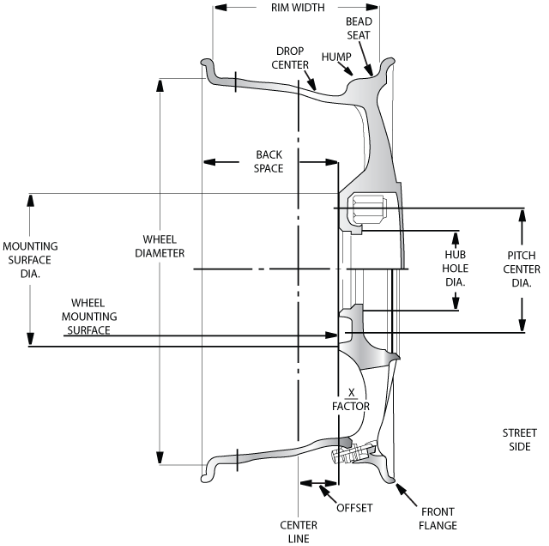
Figure 2 – Wheel Cross Section
The ultimate solution was much simpler. Based on some investigations in the OEM plant, we found that the lubricant “soap” used in the mounting process was part of the problem. While it worked fine for many tires, in this case with high and prolonged air flows it became tacky and acted to prevent the bead from sliding over the wheel safety hump. To make matters worse, when the problem first occurred the plant decided that adding more “soap” would solve the problem. So, what became an adhesive was even thicker and more uniform on this specific tire mounting machine line. After some experimentation, we found a better “soap” that allowed the bead to slide over the safety hump with less friction. Also, a check of tire pressure was added at the end of the production line.
So, the vibration analysis was not the solution to the problem, but it was part of the detective story. It helped to understand the dynamics of the process. This allowed the team to have confidence that the tire construction or design was not the source of the problem. This allowed us to go back to the mounting process and work with the assembly plant and resolve the problem with their cooperation.
Like many detective stories we had to prove who was not the “murderer” to identify the real culprit. Maybe this was not a classic “who done it”. There were no locked rooms or smoking guns. However, there were a lot of people scratching their heads trying to understand what was going on. At the same time there was a very irate customer calling meetings and making phone calls accusing us of providing defective tires. In the end the car was well received and successful. The motoring press raved about the vehicle’s handling, not knowing the difficulties we had experienced.
I am sure many of you have interesting detective stories, probably better than this one. We would like to hear them.