Vibration and Noise Monitoring at the Santa Monica Pier Bridge Replacement Project
By Christian Fogstad, Austyn Crites, Kush Parashivamurthy, and Marcus Pacheco
Background
Construction in tight, public environments has a way of turning “small” impacts into big problems. A few seconds of heavy equipment vibration can feel like a major event to someone standing nearby, and a brief spike in noise can spark complaints, delays, or questions about damage – especially when the work is happening next to older infrastructure, structures or buildings. That is why vibration and noise monitoring has moved from a niche precaution to a practical tool: it replaces guesswork with data and helps teams manage risk before conflicts arise. “Saying something did or did not happen, is not the same as proving something did or did not happen” quote Dr. C.H Dowding.
Currently one of California’s most recognizable coastal landmarks, The Santa Monica Pier Bridge Replacement Project is a good example of this predicament. Construction is taking place alongside aging structures, active pedestrian areas, utilities, and commercial activity. Demolition, heavy equipment operation, compaction, and material placement all have the potential to generate vibration and noise; the question is not if the public will be affected, but how the project team can prove clearly and credibly that such impacts are being appropriately managed.
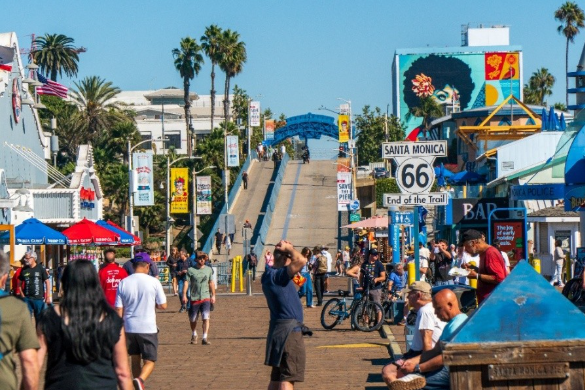
The Santa Monica Pier
Thus, this project’s project management team required a monitoring program with three clear objectives:
- Protecting existing surrounding structures and assets.
- Maintain compliance with applicable standards while monitoring according to project-specific pre-defined thresholds.
- Provide reliable, near real-time information for quick decision making.
This article shares lessons learned from how the monitoring was planned and is currently deployed and interpreted.
Background
Typically, any landmark site comes with a wide stakeholder circle. On The Santa Monica Pier Bridge Replacement Project (hereafter the Pier), this team includes the project owner, municipal representatives, general contractors, subcontractors, monitoring specialists, and regulatory authorities. Equally important are the adjacent operators and the surrounding community, because comfort and perception are integral parts of the overall risk.
One early takeaway has been clear: monitoring serves as much as a community-outreach platform as it does an engineering control and evaluation tool. When expectations are not aligned before work commences, parameters such as what is being measured, where measurements occur, which thresholds apply, and how exceedances will be handled, may quickly escalate into a dispute once unexpected noise or vibration happen.
At the Pier, such concerns are not theoretical as aged timber and concrete elements may exhibit lower tolerance for repeated energy input and fatigue exposure. Added to these structural concerns are the human comfort impact of publicly occupied areas and the fact that municipal projects carry higher taxpayer accountability. This combination makes vibration and noise monitoring essential.
Approach
Carefully considered monitoring projects starts with the basics: understanding the environment and establishing a baseline. Baseline work is especially valuable because it provides the “as-is” or current conditions of a proposed construction site. No site is 100% “quiet” and free of noise and vibration. At the Pier, pedestrian, nearby vehicular traffic, and ocean activity create their own vibration and noise signatures. Capturing ambient levels early makes it easier to answer, “Was that construction related, or was that just the Pier being the Pier?”. Based on the ambient readings the overall construction monitoring scope was established as listed below.
- Protecting nearby buildings and infrastructure
- Safeguarding community health and comfort
- Complying with legal and regulatory requirements
- The city of Santa Monica established the threshold based on the structure type and age.
- Two vibration thresholds were established:
- 0.2 in./sec PPV – established under Coastal Development Permit Special Condition #7 – as the warning level.
- 0.5 in./sec PPV – the damage-potential threshold for transient vibration sources.
- Technically, the monitoring specifications were consistent with the USBM RI 8507 standard
- For noise, the threshold was 90 dBA, which reflects +5 dBA above ambient conditions.
- Guiding construction planning and equipment selection
- Managing stakeholder expectations
- Reducing project risk and liability
Monitoring locations were deliberately selected to capture construction-induced vibration and noise, not simply placed where installation was deemed convenient. For vibration monitoring, the project team evaluated structural behavior, load paths, proximity to anticipated activities, and areas where stakeholders were most sensitive or concerned. With a limited number of systems available, the real work lay in choosing positions that best represented how the structure would respond and then maintaining stable, well-coupled installations throughout the project.
Similarly, noise monitor placement required thoughtful consideration to ensure measurements reflected conditions at the nearest sensitive receptors, avoided or properly accounted for localized noise sources, and remained reliable under prevailing wind and weather patterns. The overview below provides selected monitoring locations.
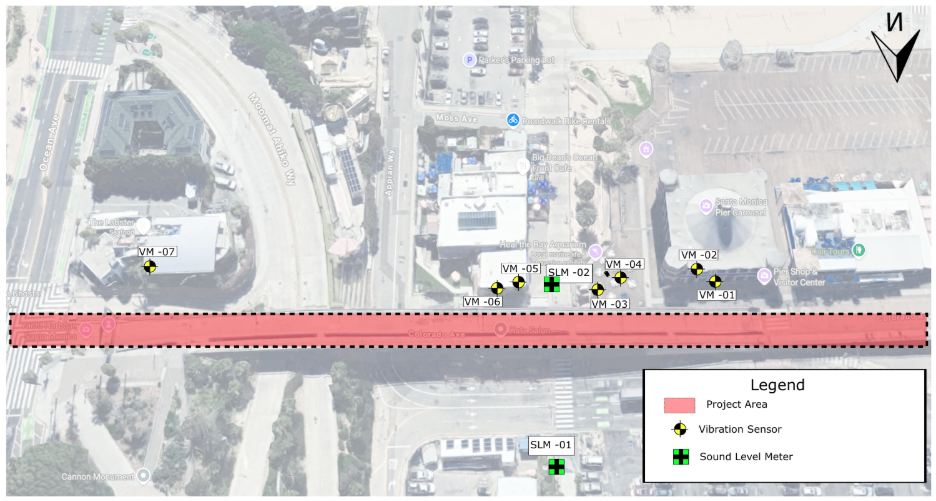
Monitoring locations at the Pier
Deployment in a coastal, public setting introduces its own set of challenges. Vibration sensors require protection from salt air and moisture, along with secure, stable coupling to ensure that transmitted energy is captured accurately. Proper orientation is equally critical, allowing the system to evaluate true directional three‑axis motion rather than random data.
Power and communications matter more than people expect; a monitoring program that drops offline at the wrong time undermines confidence. Access windows are constrained by public use and construction sequencing, so installations and checks are coordinated around low-traffic periods.
The picture below illustrates a typical vibration installation.
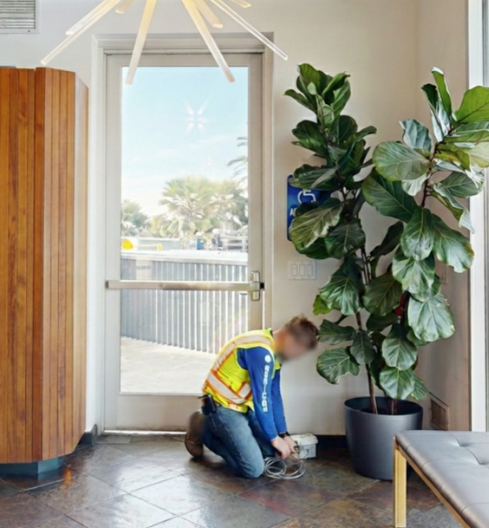
Typical vibration monitoring placement.
Selecting systems which provide near real-time data access was a deliberate choice. On a high-visibility job, waiting days to review logs and data is not sufficient. When levels rise, the team needs to quickly ascertain approaching thresholds and whether the activity should be adjusted.
Collecting accurate data is only the beginning. The real value of monitoring emerges through thoughtful analysis and interpretation by transforming raw measurements into insights that guide decisions. This exercise validates performance and ultimately protect people and projects. In the United States, peak particle velocity (PPV) is most commonly used when evaluating vibration, while dBA provides a familiar reference point for communicating noise levels. Experienced reviewers also consider duration, axis dominance, and, when available, frequency content to understand what likely produced an event and whether it is meaningful or related to construction activity. Not every spike represents a risk; informed judgment is what prevents both alarm fatigue and complacency.
Typical sources include heavy equipment operation, demolition activities, compaction, and traffic operations. When vibration or noise levels approach predefined thresholds, the project team can review methods and sequencing to adjust equipment use or change the timing of certain activities. The benefit is fewer unnecessary shutdowns. Instead of reacting to perception, the team can respond to measured conditions, with a clear record of what happens and why.
Reporting is tailored to support decisions. Time-stamped event summaries, trend graphs, comparisons to thresholds, and short interpretive notes help keep everyone informed using the same data set. The value chain is straightforward: monitoring leads to analysis, analysis leads to reporting, and reporting supports data driven decision-making.
The outcomes are what project teams seek on a public, complex site: compliance with established criteria, no documented vibration-related damage attributable to construction, and sustained stakeholder confidence. History shows that monitoring improves stakeholder conversations. When questions arise, the team has objective records rather than anecdotes. When adjustments are needed, they can be targeted and proportionate.
Five lessons have emerged.
- Baseline conditions matter most in dynamic public environments.
- Monitoring system reliability is the priority when you have a small number of measuring points.
- Action levels must be paired with clear response steps.
- Expert interpretation is what turns “data” into “decisions”.
- Communication is part of the scope: credibility depends on clarity as much as measurement.
Thoughtful vibration and noise monitoring are not just damage prevention. At places like the Santa Monica Pier, it is about enabling construction to move forward while balancing progress with preservation and doing it in a way that is technically credible and publicly defensible.
Done well, monitoring becomes the calm voice in the room (or on the Pier) when tensions rise.
Bibliography
Dr. Charles Dowding Construction Vibrations, Prentice Hall Inc., Englewood Cliffs, NJ, 1996, 620pp. Third Printing 2008.
RE 8507. Report of Investigation 8507 – Structurer Response and Damage Produced by Ground Vibration From Surface Min Blasting by D. E. Siskind, M. S. Stagg, J. W. Kopp, and C. H. Dowding.
Transit Noise and Vibration Impact Assessment Manual FTA Report No. 0123 Federal Transit Administration.