Manduca sexta caterpillars hear using hairs as flow-sensing receptors
Sara Aghazadeh1& Aishwarya Sriram2, Carol Miles2, Ronald Miles1 1Mechanical Engineering Department, 2Biological Science Department, Binghamton University
It is about 150 years since Hermann von Helmholtz established the physical basis of human hearing, describing how acoustic pressure is converted into mechanical motion in the ear. Shortly after that, inventors such as Emile Berliner and Thomas Edison developed early microphones for telephony, translating similar pressure variations into electrical signals. Today, there are billions of microphones manufactured each year for various applications in communications, entertainment, human health diagnostics, and transportation nearly all based on the detection of sound pressure, inspired by the mechanisms employed in human hearing.
We hear the sound pressure created when a sound wave arrives in our ears. But in that traveling sound wave, the air particles are actually moving back and forth as the sound pressure fluctuates in time and space. In a great many animals, like insects, they hear that sound by detecting the air-flow rather than the fluctuating pressure detected by our eardrums. Detecting a flow is another way to hear rather than detecting pressure.
In this research, we explore how insects perceive sound-induced airflow. An aim of this work is to learn how to create MEMS microphones that are designed to detect this flow rather than detect sound pressure, as is done in essentially all microphone designs since the time of Edison’s telephone. We investigate the hearing mechanism of Manduca sexta caterpillars- a common garden pest, the tobacco hornworm- to examine whether their hearing is due either to the detection of airborne sound using any tympanal membrane to sense the fluctuating pressure of a sound wave, or due to sensing the flow of the air particle motion using tiny hairs on their body. We also examine whether this animal is able to detect sound due to the sound-induced vibration of the surface (such as a leaf or plant stem) that they grasp with their feet.
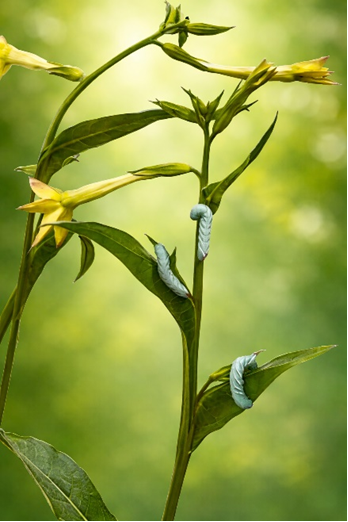
Figure 1.Manduca sexta caterpillars on tobacco plants
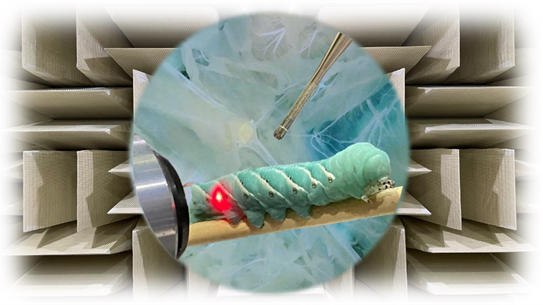
We examined the caterpillars’ behavioral responses to sound using two key targeted frequencies, pure tones of a low frequency at 150 Hz, and a high frequency of 2000 Hz. Previous studies have found strong behavioral responses at 150 Hz in tuning curve experiments at 80-90 dB. By using laser vibrometry, we measured the sound-induced motion of a thoracic hair on the caterpillar’s body, and we observed a natural resonance of the hair at 2000 Hz. While we don’t normally expect insect hairs to be effective sound detectors at such high frequencies, this observation motivated further examination to look for behavioral responses at this frequency.
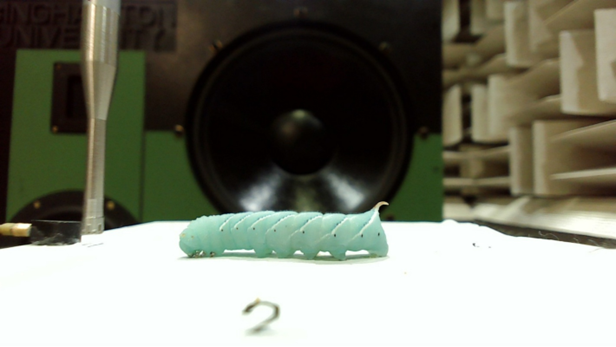
Figure 2. Sound Exposure Experimental setup; Play sound and observe caterpillar behavioral response at 150 Hz in the anechoic chamber.
We monitored caterpillars’ behavioral responses to vibrations of the substrate that the caterpillars were holding on to, and to air-borne sound while we recorded the amplitude of the substrate vibration using an accelerometer. The caterpillar responses were classified into three categories: jump startle– a jerky reaction, lifting of thoracic and anterior abdominal segments; twitches–localized movements in any segment, freezing– cessation any movement. The stimulus level that was just high enough to elicit a behavioral response was considered as a detection threshold. You can find their reaction to sound here: https://sites.google.com/binghamton.edu/natures-microphones/home
The results revealed that the caterpillars were 10-100 times more responsive to airborne sound than sound-induced vibration of the substrate detected by their feet; this confirms that they perceive airborne sound at a low-frequency of 150 Hz and a high-frequency of 2000 Hz. Also, M. sexta caterpillars display graded responses to sound stimuli corresponding to the intensity of the stimuli.
This raised a question: if they hear, where are their ears? To address this question, we performed the ablation method, removing targeted hairs on their thorax and abdomen segments on their body. The result of the behavioral response comparisons before and after removal of the hairs shows a greatly reduced ability of the caterpillars to detect sounds without the hairs. We found that thoracic hairs are primarily sensitive to higher frequencies, around 2000 Hz, while long abdominal hairs are associated with lower frequency detection, around 150 Hz. This suggests that different hair receptors contribute to detecting different components of the acoustic signal, and provides evidence of non-tympanal sound detection in these caterpillars for these specific frequencies.
Furthermore, we developed a mechanical setup to figure out whether these caterpillars respond to the air particle velocity or a sound pressure. A loudspeaker was used as a dipole source, producing distinct acoustic fields: A pressure-dominated field in front of the speaker, and a particle velocity–dominated field to the side.
We first determined the behavioral thresholds (SPL in dB) in the velocity-dominated field, where caterpillars exhibited a jump startle response. Then, we examined caterpillars’ behavioral response in the field dominated by pressure with the same SPL. The result showed that much higher SPL is needed to elicit response in the pressure field than when the sound field is dominated by particle velocity.
The ratio of the pressure to the velocity in a sound field is the acoustic impedance. Using measured impedance values as a function of distance from the speaker, we estimate that the pressure required to elicit a response in the velocity field (side) is substantially lower than in the pressure field (front). This supports the hypothesis that Manduca caterpillars are more sensitive to particle velocity (air motion) than to sound pressure. The results suggest that these caterpillars use sound velocity as a cue to estimate the distance of an approaching parasitoid wasp. They freeze when the threat is distant, twitch as it approaches, and jump startle when it is very close.
[2026] The Research Team. All rights reserved. All media, including images, figures, data, and videos contained in this presentation are the intellectual property of the research team. Unauthorized use, reproduction, or distribution is strictly prohibited.
The research team is as follows with equal authorship.
Sara Aghazadeh1 & Aishwarya Sriram2, Carol Miles2, Ronald Miles1 1Mechanical Engineering Department, Binghamton University 2Biological Science Department, Binghamton University State University of New York (SUNY), United States
Our team:

Figure 3. Credited by Binghamton University; Team photograph – Greg Schuter & John Brhel
1Sara Aghazadeh: saghaza1@binghamton.edu & 2Aishwarya Sriram: asriram@binghamton.edu
1Prof. Ronald Miles: miles@binghamton.edu & 2Prof. Carol Miles: cmiles@binghamton.edu
1Mechanical Engineering Department & 2Biological Sciences Department, Binghamton University, NY, USA