Vibration data for mechanical equipment: shake up the paradigm
By Brandon Cudequest, bcudequest@acentech.com, Acentech
Vibration isolation guidelines are based in industry best practice, owing much of their current form to the seminal work done by vibration isolator manufacturers in the 1960s (Mason, 1966). Engineers like Norm Mason understood that vibration isolation is a multi-degree of freedom problem and cannot be solved through single degree of freedom analysis. In addition to the floor deflection, engineers need to consider vibration severity: a large fan is capable of greater force than a smaller fan (think Newton’s second law). Isolator deflection requirements need to consider these factors and cannot be based on the equipment rotational speed (i.e., forcing frequency) alone.
These isolation guidelines were adopted into the “Noise and Vibration” chapter of the Handbook—HVAC Applications published by the American Society of Heating, Refrigerating, and Air Conditioning Engineers (ASHRAE). They became ubiquitous and are the basis for many mechanical engineers’ specifications. Over the years, these recommendations have marginally changed as new equipment technologies come to market and ASHRAE adapts to reflect contemporary practices.

Figure 1 – Comparison of ASHRAE fan vibration isolation guidelines from 1973 and 2023.
The vibration isolation section of the “Noise and Vibration” chapter is undergoing revision for the 2027 edition of ASHRAE Handbook—HVAC Applications. Chief among the changes is a prescriptive and performance-based approach for isolator selection henceforth called “Simplified Engineering” and “Advanced Engineering” respectively. The Simplified Engineering approach will look familiar: an engineer selects vibration isolation measures from a table based on best practices. The Advanced Engineering method allows an engineer to select vibration isolation measures based on detailed analysis of the vibration source, sensitivity of adjacencies, and the structure type.
ASHRAE’s Committee on Sound and Vibration will continue to help engineers and consultants understand the nuances of these approaches. For now, this article is fundamentally concerned with the question, “what does the industry need to make the Advanced Engineering method a success”? Is there a feasible source-path-receiver model that works for vibration? Short of Finite Element Analysis (FEA) or extensive field testing, what pieces of this puzzle are achievable on most projects?
To get from force to velocity, we need to characterize at least three components: the equipment vibration levels, the dynamic performance of the isolation mount, and the frequency response function of the floor structure. It’s relatively straightforward to understand these elements separately and at discrete frequencies, it’s another to know the application-specific values and possible mode coupling across a broad range of frequencies.
When I presented this content at the Acoustical Society of America (ASA) Honolulu meeting, I offered a live poll to attendees. The question was “when designing vibration isolation, I am least sure of…” The options were “Equipment Force Input,” “Isolator Insertion Loss,” “Structural Response,” and “All of The Above.” Based on 16 respondents here are the results:
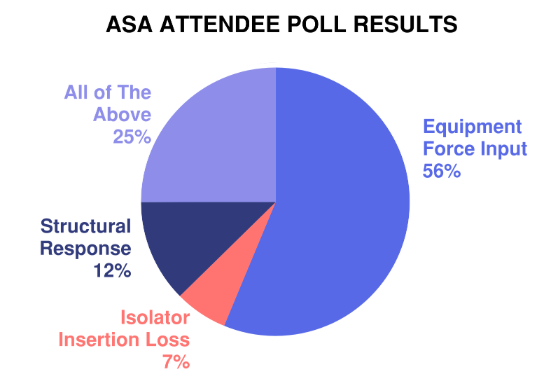
Figure 2 – Results from ASA attendee poll
“Equipment Force Input” was the overwhelming first choice at 56%. If “Equipment Force Input” and “All of the Above” are combined, there is a significant uncertainty around equipment vibration. Let’s break down these topics into their fundamental components and explore the uncertainty around each element.
For equipment vibration, two major sources are unbalance and misalignment forces (see Figure 3).
Figure 3 – Typical vibration forces in rotating and reciprocating equipment.
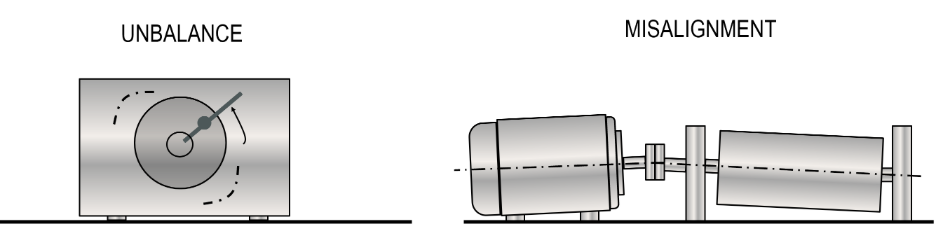
Unbalance and misalignment forces have known causes and frequency relationships related to the equipment rotational speed. We’ll ignore any bearing-related vibration forces, which are more indicative of the age and condition of the equipment. For certain equipment types, there are industry guidelines for balance quality and vibration severity. For fans, this is AMCA 204. Similar standards exist for pumps (ANSI/Hydraulic Institute Standard 9.6.4) and cooling towers (CTI 163).
In subsequent conversations with consultants and manufacturers following the ASA meeting, there is significant uncertainty in translating these values to actual field conditions. For example, AMCA 204 is a lab rating, likely at one operating point. How does this change as the fan is mounted to a unit chassis and operating at non-peak conditions? There are relatively few test standards for equipment vibration, such as ISO 12354-5:2023, but the test rigs are limited to lighter weight equipment. Useful for small heat pumps but not practical for commercial air handling units.
Next, we have to consider isolators. Consultants often oversimplify elastomers as springs and use static deflection as a guarantor of natural frequency. Ultimately, engineers need the dynamic stiffness of the isolator as this raises the natural frequency of the isolator well above theoretical models (see Figure 4). The natural frequency of a spring isolator is easier to model, but high-frequency surge frequencies are difficult to predict for different load conditions (Ungar, 2007).

Figure 4 – Comparison of natural frequency of a theoretical spring and other isolator types. (Eberhart, 1966)
Several groups are pushing the state of the art in isolator insertion loss understanding. The University of Kentucky Vibro-Acoustics Consortium has explored the feasibility of the ISO 10846-1 test rig and an impedance matrix approach to quantifying isolator performance (Sun, 2015). Jerry Lilly has created a simple but effective rig and presented insertion loss values for springs and waffle pad-style isolators (Lilly, 2024). We’re getting close to understanding isolators in ways that go beyond the simple static deflection curves.
Finally, engineers have to know the response of the floor structure and the resulting velocity. This requires close collaboration with the structural engineer during design. At a base level, the engineer and consultant should know the max acceleration caused by the marginal deflection of equipment. It’s tempting to focus solely on the structural stiffness but if we recall our basic transmissibility curve, damping plays a significant role in the amplification response at resonance. Both stiffness and damping need to be optimized. The level of modeling and analysis should be scaled to the complexity and severity of the vibration problem and the sensitivity of the receiver.
A refined analysis is possible if engineers have access to the structure, which can be the case in renovation applications or if the consultant has scope that facilitates mockups and/or in-progress site verification testing. If the building does not yet exist, it is possible to use FEA to predict future structural responses, but this is less certain than actual field measurements. The Papadimos Group recently presented an approach for predicting mechanical equipment floor vibration using mobility and blocked forces (Young, Wowk, & Solheim, 2025). This level of analysis is typically performed by seasoned vibration experts and may be outside the realm of consultants focused on general building acoustics.
In conclusion, vibration isolation design is often based on the misalignment of equipment driving frequency and amplitude, natural frequency/dynamic stiffness of the isolator, and forced response of the structure. There is some uncertainty in isolator performance and structural response functions; however, the biggest knowledge gap lies in equipment force data. The path forward is to develop test standards, but we need consensus, expert opinions, and manufacturer buy-in on an approach. Have an interest in pushing the state of the art through research or standards? Contact me! Through my roles in both ASHRAE and ASA, I can put you in touch with other interested parties.
Bibliography
Eberhart, L. (1966). Vibration and Structure-borne Noise Control. ASHRAE Journal.
Lilly, J. (2024). Acoustical performance of steel coil springs for vibration isolation. INTER-NOISE and NOISE-CON Congress and Conference Proceedings (pp. 1244-1255). New Orleans: Institute of Noise Control Engineering.
Mason, N. (1966). Noise and Vibration Problems and Solutions. ASHRAE Local Chapter. New York.
Sun, S. (2015). Determination of Isolation of Isolator Transfer Matrix and Insertion Loss with Application to Spring Mounts. Lexington: University of Kentucky.
Ungar, E. (2007). Chapter 59: Structural Damping and Use of Passive Damping Materials. In M. J. Crocker, Handbook of Noise and Vibration Control (pp. 1186-1196). New Jersey: John Wiley and Sons.
Young, C., Wowk, R., & Solheim, J. (2025). Predicting mechanical equipment floor vibration using mobility and blocked force. Proc. Mtgs. Acoust. 56. Acoustical Society of America.