“Good Vibration Measurements, Criteria, and Standards”
Author: Ethan Brush (Acentech Incorporated) ebrush@acentech.com
We experience vibrations everywhere in our world. To say that something is vibrating means that it has an oscillating motion about a fixed reference position. The word comes from Latin vibrationem, with the closest translation meaning “shaking” or “trembling”. Vibration is a concern to an enormous number of applications, so the ability to measure and quantify it is important. There are a multitude of quantitative ways to describe the motion of what is being measured. We can measure the movement as either a displacement, velocity, or acceleration; but sometimes as a jerk (derivative of acceleration) or even more obscurely as a jounce (second derivative of acceleration). When we know the frequency content of the measured vibration, usually via a spectrum analysis, conversion between all these levels is straightforward.
The most common way to measure vibration is with a piezoelectric accelerometer sensor, which when moved outputs a voltage proportional to acceleration. The SI units for acceleration are m/s2, however, the unit “g” is often used to distinguish acceleration relative to free fall on earth. A quiet basement floor ambient vibration environment in a research laboratory could be expected to measure on the order of a few tenths of micro-g’s, and shock events on aerospace components could reach several tens of thousands of g’s. This tremendous range is on par with the world of acoustics in terms of the orders of magnitude between the quietest and loudest observable sound pressure levels.
Building Vibration Criteria
Let’s focus on the huge range of vibration criteria one might encounter in the building industry. Vibrations in buildings can be bothersome or disruptive to occupants and activities. Whether they are residents trying to sleep, people who are distracted while working at their desks, or researchers trying to use a powerful microscope, the presence of unwanted vibration can be debilitating. The amount of vibration that is disruptive to a facility can vary by many orders of magnitude. The figure below presents an infographic that shows typical vibration criteria across a variety of building uses in velocity units of micro-inches/second. Research and semiconductor facilities are at the lowest level and most sensitive end of the spectrum because they can house very precise and sensitive instrumentation, often observing things at an atomic level. Above that, there are hospital spaces that may house surgery or magnetic resonance imaging (MRI) suites. Concert halls and recording studios are considered sensitive because vibrations above this range have the potential to cause intrusive structureborne noise. Animal facilities are sensitive because the animals in holding rooms have different thresholds of perception than humans, are always present (cannot be moved easily) and there can be significant consequences if the animals become stressed. An accepted average human threshold of perception to vibration is a velocity level of 8,000 micro-in/sec and is labeled on the chart (ANSI S3.18-1979). The criteria for occupants of residential and office buildings straddle this threshold. Notice how many spaces can be affected by vibration levels that we can’t even feel.
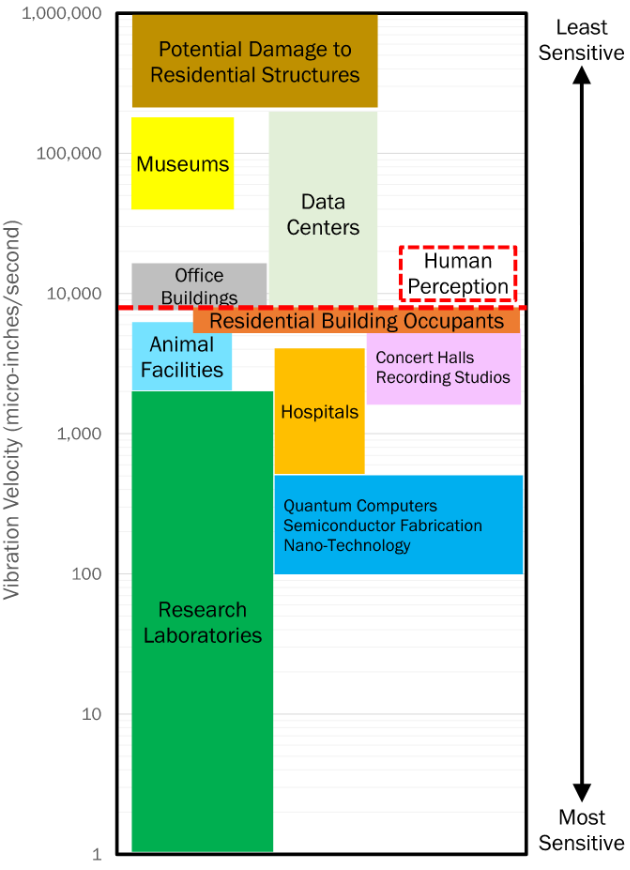
Figure 1: Typical Building Vibration Criteria
Data centers and museums are higher up on the sensitivity spectrum. Given their mission critical function (data centers) and housing of potentially irreplaceable items (museums), vibration control is still a top priority. At the very top of the range lie vibrations that may be damaging to the building structure itself.
Comparing Apples to Apples
How we describe the amplitude of vibration matters a great deal. The vibration limits on the chart above are all in terms of micro-inches/second, but even when choosing consistent units there are a multitude of ways the amplitudes with the same units can be described. We describe the amplitude of sinusoidal signals mostly as root mean square (RMS), zero-to-peak, or peak-to-peak. Choose this one wrong, and your result may be off be as much as a factor of two. Next comes the various signal processing choices one makes to arrive at a frequency spectrum such as window length, data windowing function, and frame overlap percentage. Then, one must choose the amplitudes between narrow band, 1/3 octave, octave, or even power spectral density. If any of these choices are different for two people making the same set of measurements, then the results aren’t fully comparable. To complicate things even further, some criteria are based on the peak waveform values. For a transient signal the difference between an RMS amplitude and the peak waveform value, called the crest factor, can be well over a factor of 10.
Because there are so many ways to describe a vibration amplitude, the presentation of data should include sufficient information indicating how the results were obtained so that someone else could reproduce the same processing steps. Equipment vibration specifications should also spell out exactly how to arrive at the limit values given in their documentation. Some equipment vendors get this right, and others do not.
Footfall Vibration Measurement Standard
It is often necessary to evaluate the floor vibration performance of existing buildings due to people walking. A common approach is to measure floor vibrations induced by a person walking and assess whether the floor is suitable for its intended use (e.g., residential, office, research laboratory). Other than a few generic guidelines there is currently no published standard for conducting footfall vibration testing in buildings. As a result, practitioners rely on their own methods for testing, data analysis, and reporting of results. This can lead to disparate results for all the reasons stated above and more.
The ASTM committee E33 on “Building and Environmental Acoustics” has created a new working group with the challenge to develop recommendations for conducting footfall vibration measurements in buildings. The hope is that whether the group produces a guide or a full standard, the building industry can have a document to follow that allows for consistent footfall vibration tests. This will be of great benefit for mass timber buildings, where the knowledge of their vibration performance and design guides is less mature than for steel and concrete buildings. Indeed, the entire building community will benefit from more consistent empirical data to further inform and validate prediction and design methods. Please reach out if you have opinions about what should be included in the ASTM recommendations for footfall vibration measurements.
References
[1] ANSI S3.18-1979
[2] ANSI+ASA+S2.71-1983+(R2012) Guide to the Evaluation of Human Exposure to Vibration in Buildings
[3] IS0 2631-2:1989, Evaluation of human exposure to whole-body vibration – Part 2: Continuous and shock-induced vibration in buildings (7 to 80 HZ).
[4] “Vibrations of Steel-Framed Structural Systems Due to Human Activity,” American Institute of Steel Construction, Design Guide 11, 2nd Edition, 2016.
Author Bio:
Ethan Brush is a principal consultant at Acentech Incorporated in Cambridge, MA. He has 20 years of engineering and project management experience directing teams in the areas of noise and vibration testing, analysis and design of vibration mitigations.